Antisemitic Incidents Report 2025
Executive Summary
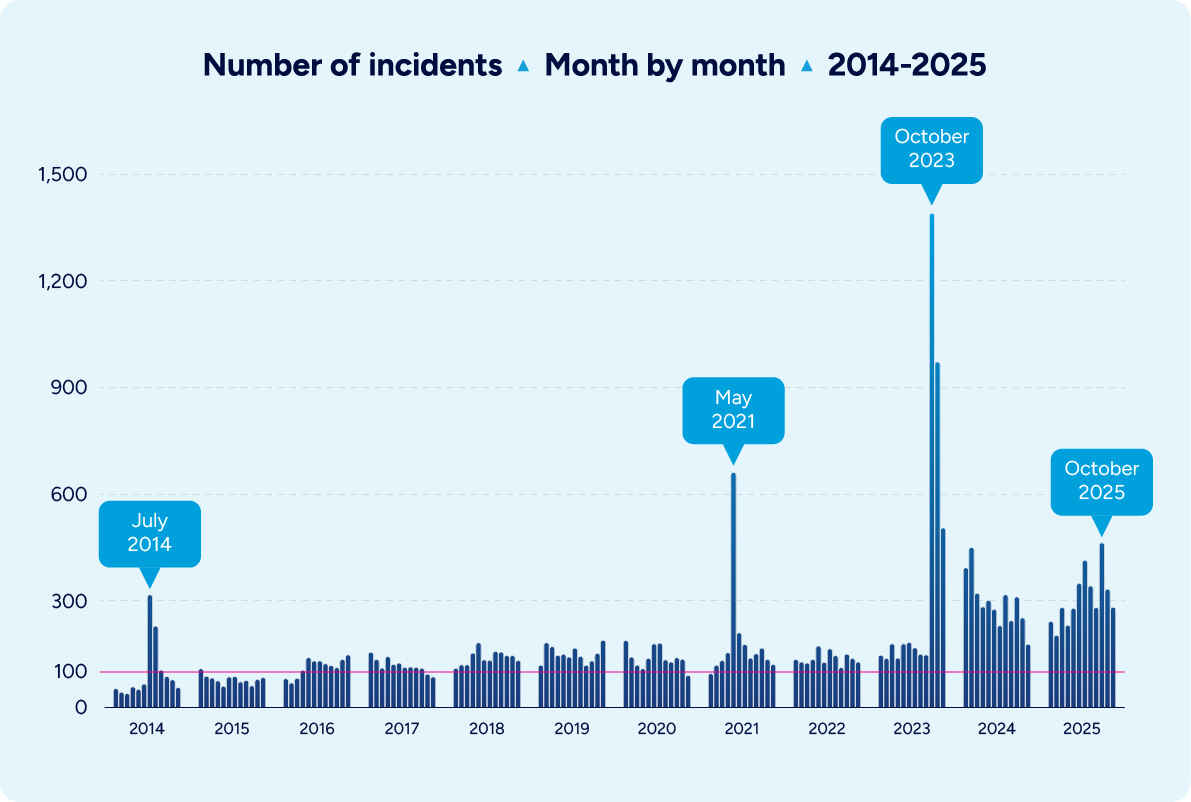
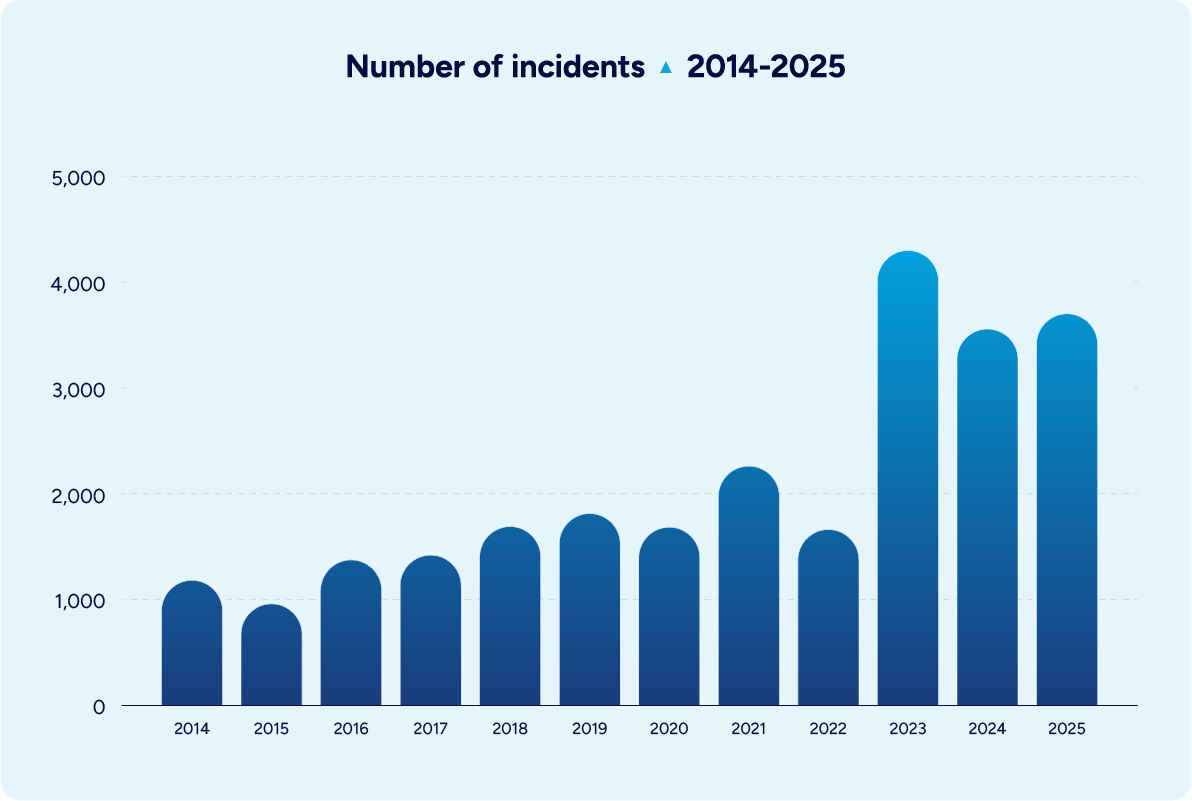
- CST recorded 3,700 antisemitic incidents in the UK in 2025, the second-highest total ever reported to CST in a single calendar year. This is an increase of 4% from the 3,556 anti-Jewish hate incidents recorded by CST in 2024, and 14% lower than the highest ever annual total of 4,298 antisemitic incidents reported in 2023. CST recorded 1,662 antisemitic incidents in 2022, and 2,261 in 2021.1
The increase from the total recorded in 2024 reflects that antisemitic incident levels remain at a significantly higher rate than was the case prior to Hamas’ terror attack on Israel on 7 October 2023. There was an immediate and significant spike in recorded cases of anti-Jewish hate in the UK in the aftermath of that attack. The subsequent war, and its grip of public and media attention even during periods of ceasefire, has continued to impact the amount and nature of anti-Jewish hate reported in the 27 months since that date.
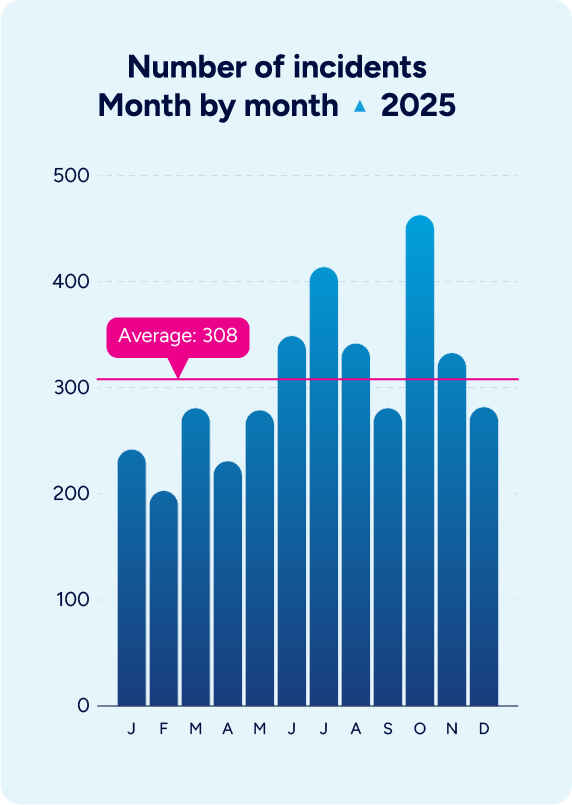
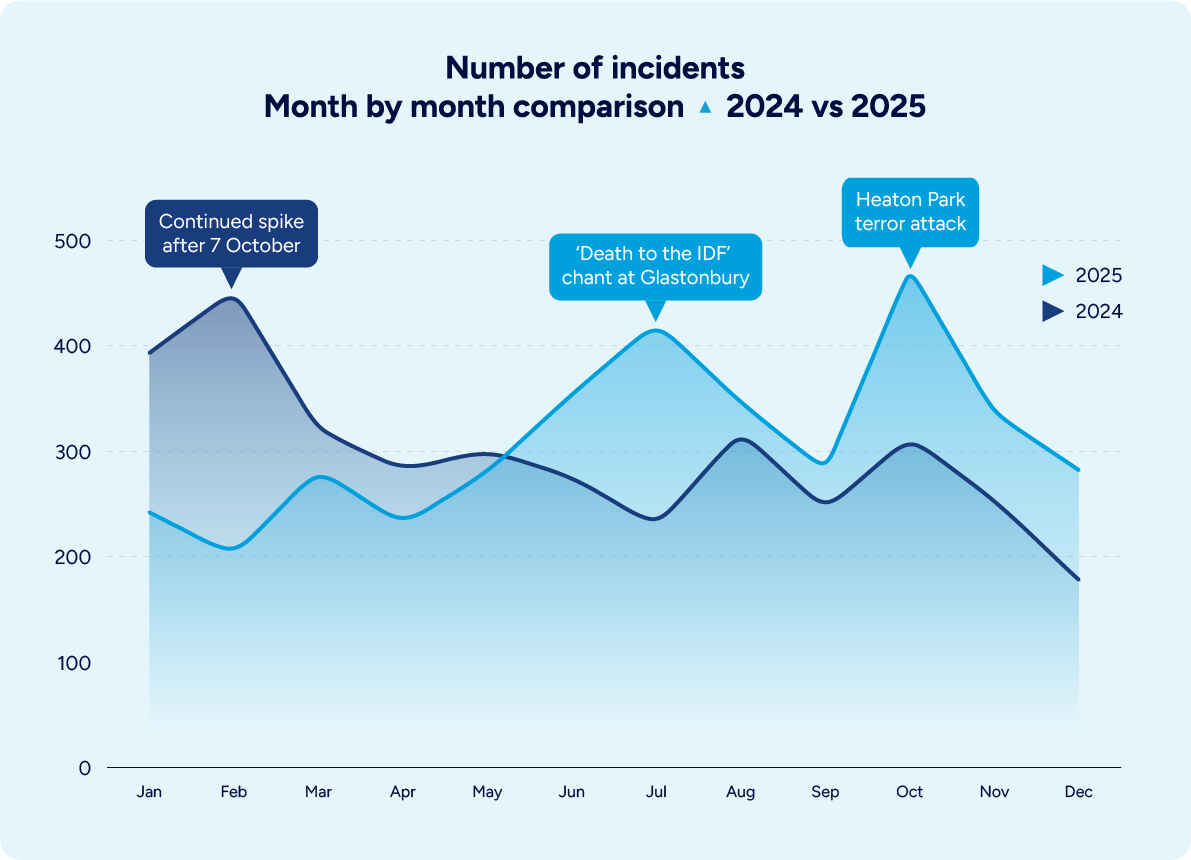
In 2025, CST recorded an average of 308 antisemitic incidents per month, exactly double the monthly average of 154 incidents reported in the year preceding 7 October. For the first time ever, CST recorded over 200 cases of anti-Jewish hate in every calendar month in 2025. Prior to October 2023, monthly incident totals exceeding 200 had only been reported to CST on five occasions, each coinciding with past periods when Israel was at war.
The most severe antisemitic incident during 2025 was the fatal terrorist attack at Heaton Park Synagogue on Yom Kippur, the holiest day in the Jewish calendar, which resulted in the deaths of Melvin Cravitz and Adrian Daulby and left three others seriously injured. This was the first time that an antisemitic terror attack in the UK has resulted in the loss of life since CST began recording incidents in 1984.2
The terror attack in Manchester triggered an immediate spike in antisemitism. CST recorded 403antisemitic incidents on 2 October, the day of the attack, and another 40 the following day 3 October. These were the two highest daily totals for antisemitic incidents in 2025. In the week preceding the attack, CST recorded 64 cases of anti-Jewish hate. In the week that followed, CST recorded 181, marking an increase of 183% from week to week. CST recorded 463 instances of antisemitism across October, rising by 65% from 281 incidents in September. This makes October 2025 the highest monthly total in 2025 and the fifth-worst month for antisemitism in CST’s records. While CST usually records a small increase in antisemitic incidents on Yom Kippur – for example, there were 17 incidents recorded on Yom Kippur in 2024 – this alone cannot explain the much larger spike in incidents on the day of, and days following, the attack.
Of the 80 antisemitic incidents recorded across 2 and 3 October, 42 (53%) involved direct reactions to the attack on Heaton Park Synagogue. Three involved face-to-face taunting and celebration of the attack to Jewish people; while 39 were antisemitic social media posts referencing the attack, abusive responses to public condemnations of the attack from Jewish organisations and individuals, or antagonistic emails sent to Jewish people and institutions. As observed in previous years, violent attacks on Jews, whether in Britain, Israel or elsewhere, sometimes generate more anti-Jewish invective from antisemites who feel emboldened to express their prejudice.
Similarly, a smaller spike was observed in December in the wake of the Islamic State-inspired terrorist attack at a Chanukah event in Bondi Beach, Australia. This shooting claimed the lives of 15 people who attended the event. CST’s highest daily incident totals for December 2025 fell on 14 December, the day of the attack, with 16 incidents reported, and the two subsequent days, with 19 and 15 incidents recorded respectively. Of these 50 incidents, 21 directly referenced the attack on Bondi Beach – 20 online and one offline – and recycled much of the same anti-Jewish rhetoric observed in incidents reported in the wake of the attack on Heaton Park Synagogue.
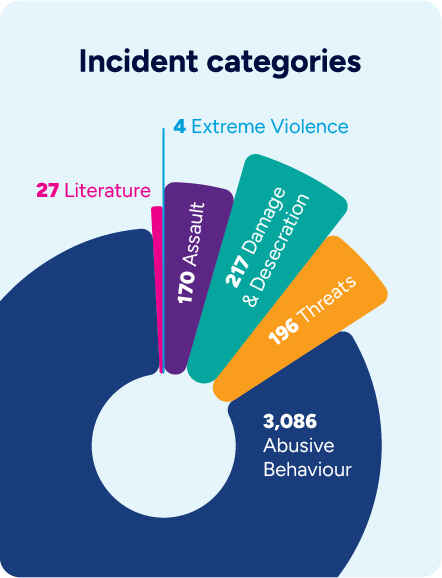
The terror attack on Heaton Park Synagogue is one of four antisemitic incidents in 2025 that were severe enough to be classed as Extreme Violence, meaning they involved a threat to life or Grievous Bodily Harm (GBH). This is double the two such incidents reported in 2024 and more than the total number of Extreme Violence cases recorded across the past three years combined.
CST recorded 170 incidents in the category of Assault, a decrease of 16% from the 202 reported in 2024. These comprise antisemitic physical attacks that did not have the intention or potential to cause life-changing or life-threatening injuries. Taken together with the four instances of Extreme Violence, physical attacks on Jewish people constitute 5% of the annual total in 2025, compared to 6% in 2024.
Cases of Damage and Desecration to Jewish property rose by 38%, from 157 in 2024 to 217 in 2025, the highest annual total ever recorded in this category. Sixty-eight of these involved damage to the homes and vehicles of Jewish people, 51 to posters, ribbons and memorials in honour of the hostages captured by Hamas, 25 to synagogues, 20 to the property of Jewish businesses and organisations (including six to public chanukiahs – a candelabra used during the festival of Chanukah), eight to Jewish schools, six to kosher food aisles at supermarkets, and three to Jewish cemeteries.
There were 196 incidents reported to CST in the category of Threats in 2025, which includes direct threats and explicit incitement of violence to people, institutions or property, rather than general abuse containing non-specific threatening language. This is a decrease of 22% from the 251 incidents of this type recorded in 2024.
CST recorded 3,086 reports in the category of Abusive Behaviour in 2025, more than in any other year bar 2023 and a 6% rise from the 2,917 such incidents logged in 2024. This figure eclipses every previous annual figure across all categories with the exception of 2023 and 2024, and forms 83% of all cases of anti-Jewish hate reported to CST in 2025.
There were 27 incidents reported to CST in the category of mass-produced antisemitic Literature in 2025, equal to the number of such cases recorded in 2024.
Of the 3,700 antisemitic incidents recorded by CST in 2025, 1,977 (53%) referenced, or were linked to, Israel, Palestine, the Hamas terror attack or the subsequent war. Each of these cases also evidenced anti-Jewish language, motivation or targeting. This was true of 52% of the incidents reported in 2024, 43% of those in 2023 and 15% of those in 2022: a year unaffected by a significant trigger event in the region.
There were 1,766 antisemitic incidents that showed explicitly anti-Zionist motivation, comprising 48% of the annual total, compared to 43% in 2024 and 31% in 2023. It is noteworthy that, over the last three years, the proportion of antisemitic incidents that display ideological anti-Zionism alongside anti-Jewish language or targeting has grown by a larger proportion than incidents that simply contain Israel-related discourse. CST recorded 462 instances of anti-Jewish hate wherein the terms “Zionism” or “Zionist” were used, often as euphemisms for “Jewishness” and “Jew”, or in conjunction with other antisemitic sentiment, rising from 423 cases in 2024 and 271 in 2023. Meanwhile, on 387 occasions, Israel, Israelis or Jewish people were equated with Nazi Germany or the Nazis, a rise from 333 such examples in 2024 and 257 in 2023.
The enduringly high incident levels and type of content reported since the initial Hamas attack on 7 October 2023 partly reflect the unprecedented length of the subsequent war, its geographical reach from Gaza to Lebanon and Iran, and its consequent continued foregrounding in media, politics and public debate. Anti-Israel protests have persisted, as did vigils for the hostages held in Hamas captivity and marches against antisemitism. Community attention on the issue of anti-Jewish hate has also been sustained at an elevated level, as has media coverage of antisemitism as a story. These various factors have contributed to an environment wherein some Jewish individuals and communities may have felt more anxious, fearing that they may become proxy targets for those who hate Israel, and those who use Israel as a cover for hating Jews. As a result, they may be more motivated to report anti-Jewish hate when they see it or experience it.
Events following the Glastonbury Festival in June offer a window into the causes of anti-Israel antisemitic sentiments, both in the immediate and long-term fallout. On 28 June, punk-rap group Bob Vylan chanted “Death to the IDF” while on stage at the festival, which was broadcasted live on the BBC. CST recorded 26 antisemitic incidents on 29 June. These incidents included 16 online anti-Jewish reactions to the chant or antisemitic responses to various individuals’ and organisations’ criticisms of Bob Vylan’s actions. This immediate, reactive spike quickly following one single event, generating renewed cultural interest in antisemitism as a viral topic, directly aligns with patterns previously identified by CST. CST recorded 32 incidents across the remainder of the year wherein the phrase “Death to the IDF” featured alongside antisemitic language or targeting, having not recorded a single incident using this phrase prior to the Glastonbury Festival (these were all incidents reported to CST and not a reflection of the total use of the phrase online or offline). This emergence of a new piece of content deployed by antisemitic incident perpetrators is symptomatic of how national culture, major news events, and social media networks, can combine to generate new developments in how anti-Jewish hate manifests.
CST recorded 1,541 instances of online antisemitism in 2025, the highest for any year and 23% higher than the 1,253 online incidents reported in 2024. At 42% of the annual total, online incidents comprised their highest ever proportion of antisemitic incidents reported to CST, compared to 35% in 2024. The increases in number and percentage of online incidents, the latter of which has risen year-on-year since 2022, in part reflects the way that antisemitic discourse relating to Israel has found a home on social media and other virtual platforms since October 2023. Of the 1,541 reports of online anti-Jewish hate, 1,080 (70%) were in some way connected to events in the Middle East. This was true of only 897 (42%) of the 2,159 ‘offline’ antisemitic incidents recorded in 2025.
This total for online incidents is only indicative, as the actual amount of antisemitic content that is generated and disseminated on online platforms is much larger. In some cases, social media has been used as a tool for coordinated campaigns of antisemitic harassment, threats and abuse directed at Jewish public figures and other individuals. Where this is the case, CST will record a coordinated campaign as a single incident, even if it involves multiple tweets, posts, messages or comments. CST does not trawl the internet looking for online incidents to log and will only record online incidents that are reported to CST by a victim, witness or other third party, and where either the offender or the victim is based in the UK.
In 2025, CST recorded 57 antisemitic incidents at Jewish schools, compared to 63 in 2024. A further 70 incidents involved Jewish schoolchildren away from school, usually on their daily commute, often identifiably Jewish on account of their uniform, falling from 89 incidents of this type in 2024. Seventy-seven cases of anti-Jewish hate targeted schoolchildren and staff at non-faith schools, decreasing from 114 in 2024. Together, this constitutes a total of 204 school-related instances of antisemitism reported in 2025, a net fall of 23% from the 266 such incidents in 2024.
A decrease was also logged in the number of antisemitic incidents reported in higher education. In 2025, 78 cases of anti-Jewish hate were recorded by CST in which the victims or offenders were students or academics, or which involved student unions, societies or other representative bodies. Of these, 39 occurred on campus or university property, and 25 occurred online. This is a significant drop of 41% from the 133 university-related incidents reported in 2024, when 68 happened on campus and 65 online. Of the 78 instances of antisemitism in higher education, 56 (72%) included references to Israel and the war in the region alongside anti-Jewish motivation or targeting. This was the case in 53% of incidents that were not related to universities.
One hundred and seventy-seven antisemitic incidents in 2025 targeted synagogues, including buildings, congregants and staff. Congregants on their way to or from prayers were victims in a further 50, compared to 163 and 59 respectively in 2024. This is a net rise of 2% in incidents affecting synagogues and the people travelling to, from, or already inside them, from 222 cases to 227 reports – an annual record. Synagogues are symbolic and often very visible targets for those seeking a target for their anti-Jewish hate, and every attack on a synagogue is an attack on Jewish life itself.

CST recorded 984 antisemitic incidents in 2025 that involved Holocaust or Nazi-era references, making up 27% of the annual total. This is an increase of 7% from 921 such incidents in 2024 (26% of that year’s figure). Among these 984 reports were 207 cases involving celebration of the Holocaust, the glorification of its perpetrators, or a desire for it to be repeated, up by 47% from 139 such incidents recorded in 2024. This is more than four times the 50 incidents reported in 2025 that involved Holocaust denial or minimisation, a fall of 19% from 62 in 2024. On 13 occasions, the offender simultaneously denied and glorified the Holocaust, displaying the hypocrisy and warped logic that underpin antisemitic thought. Of the 207 instances of Holocaust glorification, 66 (32%) also referenced the Middle East, asserting that Israel has justified Hitler’s plan for Jews, yearning for a repeat of the Holocaust, or lamenting his failure to eliminate the entirety of the world’s Jewish population, without which there would be no Israel. CST recorded 253 incidents that showed explicit far-right ideology, rising by 44% from 176 reports with evidence of this type of extremism in 2024.
One hundred and thirty-six antisemitic incidents recorded by CST in 2025 contained discourse relating to Islam, Muslims and Islamist groups, falling from 157 such incidents in 2024. Of these, 28 were motivated by extreme right-wing ideology, and showed hostility to Muslim and Jewish communities simultaneously. There were 39 cases of anti-Jewish hate reported to CST that evidenced radical Islamist ideology, falling from 65 in 2024, while another religious ideology was present in 61 incidents, compared to 55 in 2024.
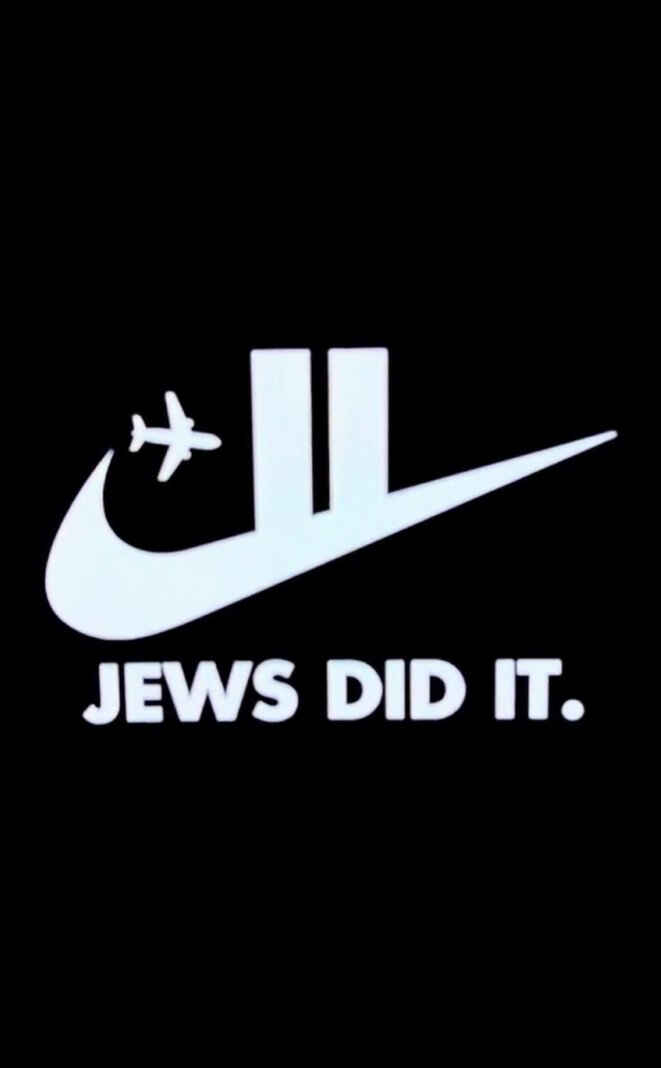
Conspiracy theories were present in 666 (18%) of the 3,700 reports in 2025, an increase of 36% from 489 (14%) of the 3,556 incidents in 2024. From these, 467 spoke of malevolent Jewish manipulation of global politics, media, finance and other walks of life, compared to 347 in 2024. One hundred and seventy-four involved lies regarding religious rituals and practices, rising from 108 in 2024. These incidents often invoke the Blood Libel myth, which has been given new life by antisemites who frame the tragic death of innocent Gazan children as a result of Jewish lust for infant blood. Eighteen incidents involved lies about the origins of Jewishness in attempts to undermine the legitimacy of any notion of a modern Jewish identity or nationhood, rising from 15 in 2024.
In 2025 CST recorded 54 incidents connected to specific political parties or their supporters.4 Twenty of these were linked to discussions around the Labour Party: a decrease from 2024, when 50 incidents were Labour Party-related. Fourteen of these 20 instances of anti-Jewish hate also made reference to the Middle East. There were seven antisemitic incidents linked to the Green Party, four of which targeted its Jewish leader Zack Polanski with abuse (a rise from one Green Party-related incident in 2024); seven antisemitic incidents associated with the Reform Party (none in 2024); five with the Conservative Party (compared to two in 2024); and 15 with a range of other parties and candidates. These 54 politically motivated incidents are fewer than the 74 recorded in 2024, during which a General Election was called. Thirty of these 54 incidents contained rhetoric pertaining to the Middle East, of which 11 alleged that British politicians are under Israel, Jewish or Zionist control.
In total, 2,821 (76%) of the 3,700 antisemitic incidents reported to CST in 2025 contained one or more anti-Jewish political or ideological discourses, motivations, tropes or conspiracy theories. This was the case in 2,610 (73%) of the 3,556 incidents reported in 2024, 2,731 (64%) of the 4,298 logged in 2023, and 834 (50%) of the 1,662 recorded in 2022. The year-on-year rise in politicised, ideological, conspiratorial and, in some cases, fundamentalist language within reports of antisemitic hate is concerning, and points to a growing pervasiveness of extremist attitudes about the Jewish community in the UK. Meanwhile, 578 incidents, 20% of the 2,821 incidents including at least one of these discourses, featured two or more of these often-disparate narratives, reflecting the complexity of contemporary antisemitism and the challenge of eradicating it.
CST recorded 1,844 antisemitic incidents in Greater London, falling by 1% from the 2024 total of 1,863 London-based incidents. Four hundred and twenty-five cases of anti-Jewish hate were reported in Greater Manchester, a decrease of 11% from 480 incidents in the corresponding area in 2024. Together, they comprise 61% of the national total, whereas they formed 66% in 2024. This suggests a slightly broader geographical spread of antisemitic incidents in 2025. Nevertheless, these hubs of Jewish life are where the majority of the UK’s Jewish community resides and remain the main targets of anti-Jewish prejudice.
Within Greater London, 816 antisemitic incidents occurred in Barnet, the local authority with the largest Jewish community in the UK. There were 191 instances of antisemitism recorded in Westminster, 139 in Camden, 59 in Hackney and 57 in Harrow. The figure for Greater London would be higher, were it not for a technical problem that has disrupted the flow of reports received from the Metropolitan Police as part of CST’s information exchange with police constabularies across the country. CST’s collaboration with police is of huge value and remains a core component of CST’s daily work.
Since 7 October 2023, the borough of Westminster has ranked higher within CST’s antisemitic incident data for Greater London than in previous years, due partly to the prevalence of political protests and other events in the borough. While mostly peaceful, these occasions have attracted individuals who were reported to CST for anti-Jewish placards, leaflets and hate speech. At least 47 antisemitic incidents took place in Westminster either at, or in transit to or from, anti-Israel demonstrations or vigils for the hostages. Meanwhile, 31 instances of anti-Jewish hate in the borough targeted Jewish organisations, 24 targeted synagogues, and 15 targeted high-profile individuals.
Of Greater Manchester’s 425 antisemitic incidents recorded in 2025, 135 occurred in the City of Manchester, 113 in Bury, 89 in Salford, 20 in Stockport and 15 in Trafford.
CST recorded an antisemitic incident in every single mainland police region in the UK in 2025, as well as two Channel Islands. In 2024, the only mainland police constabulary in which no incidents were recorded was Lincolnshire. Anti-Jewish hate manifests throughout the country. Online platforms amplify its reach, regardless of an individual’s proximity to a Jewish community.
Apart from Greater London and Greater Manchester, the police regions with the highest numbers of recorded antisemitic incidents in 2025 were West Yorkshire with 131 incidents (down from 184 in 2024); Hertfordshire with 126 (121 in 2024); Scotland with 101 (74 in 2024); Sussex with 68 (53 in 2024); and Essex and West Midlands with 67 each (compared to 61 and 64 respectively in 2024).5
Aside from boroughs in Greater London and Greater Manchester, the cities and towns in the UK where anti-Jewish hate was most frequently reported were Leeds in West Yorkshire (89 incidents); Borehamwood & Elstree in Hertfordshire (61 incidents); Birmingham in West Midlands (58 incidents); Brighton & Hove in Sussex (52 incidents); and Liverpool in Merseyside (43 incidents).
There were 741 incidents reported to CST in 2025 in which the victims were ordinary Jewish individuals in public. In at least 459 incidents, they were visibly Jewish on account of their traditional clothing, Jewish school uniforms, jewellery and insignia bearing religious symbols, or presence at public Jewish events. In 2024, this was true of 951 and 495 incidents respectively.
A record 48 antisemitic incidents were related to places of work and professional online fora in 2025, up from 33 such incidents in 2024, while Jewish businesses and organisations – five of which were youth movements – were targeted on 512 occasions, the second-highest annual total for incidents of this kind, falling by 22% from the 653 such incidents in 2024. Of these 512 reported cases, 429 (84%) occurred online, 410 (80%) contained rhetoric relating to Israel and the Middle East, and 114 (22%) involved allegations of Jewish interference in, and control over, various global affairs.
A record 263 instances of anti-Jewish hate were reported to CST in 2025 wherein the victim was an individual of public prominence, an increase of 47% from the previous annual record of 179 incidents of this nature reported in 2024. Of these, 231 (88%) took place online, 234 (89%) referenced Israel and circumstances in the Middle East, and 74 (28%) indulged in the myth of Jewish power. These totals convey the extent to which antisemites hold public figures and communal bodies, both Jewish and non-Jewish, collectively responsible for Israel’s alleged behaviour. In some cases, they are accused of buying the allegiance of British policymakers, selling their political integrity to Israel, or manipulating political decisions that impact the region. These falsehoods draw on the antisemitic conspiracy theory that Jews use financial muscle to wield influence throughout society.
There were 191 incidents that took place at people’s residential properties or affected parked vehicles in 2025, an increase from 166 incidents of this type in 2024. Fifty-six of these were perpetrated by a neighbour or somebody with a prior relationship to the victim, forming part of the 223 cases of anti-Jewish hate where this was the case, 6% of the annual total and fewer than the 243 such incidents recorded in 2024.
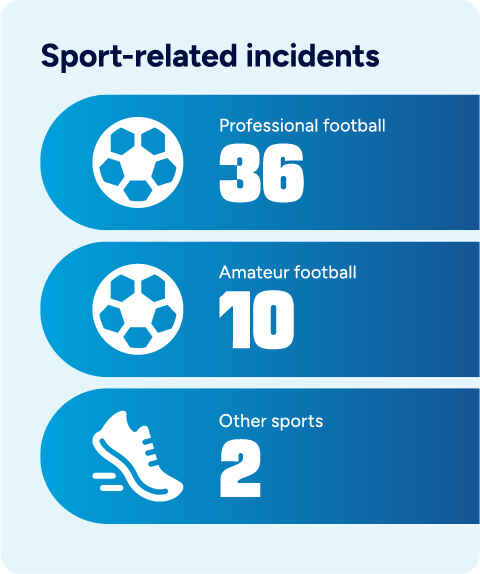
There were 36 antisemitic incidents reported to CST in 2025 that took place in the context of professional football, rising from 25 such incidents in 2024.6 Fourteen of these 36 reports were anti-Jewish comments made in the context of West Midlands Police’s decision to ban Maccabi Tel Aviv supporters from attending a match against Aston Villa in November 2025. Reports of anti-Jewish hate in grassroots or amateur football fell, from 17 incidents in 2024 to ten in 2025. A further two incidents occurred in other amateur sporting environments: one in an amateur rugby match, and one at a school sports day.
CST received a description of the victims’ gender in 1,728 of the 3,700 antisemitic incidents recorded in 2025. Of these, 971 (56%) were male; 527 (31%) were female; one was non-binary (<1%); and in 229 incidents (13%), the victims were mixed groups of males and females.
Of the 1,727 instances in which the victim or victims’ age was ascertained by CST, 1,421 (82%) involved adult victims, of which 44 cases involved adults over the age of 65; 207 (12%) targeted victims exclusively under the age of 18; a further 99 incidents (6% of the incidents where victim age was given) impacted mixed groups of adults and minors, meaning children were among the victims in 18% of reports of anti-Jewish hate in 2025.
CST asks incident victims or witnesses if they can describe the person, or people, who committed the incident they are reporting. Interactions between perpetrators and victims may be brief, leaving little reliable information, and while it is often possible to receive reports regarding the apparent appearance or motivation of incident offenders, this is not proof of the offenders’ actual ethnic or religious identity, nor of their motivation. In addition, many incidents do not involve face-to-face contact between offender and victim, so there is no physical description of the offender. With these caveats, CST does provide data regarding the ethnic appearance, age and gender of incident offenders.
CST obtained a description of the ethnic appearance of the offender or offenders in 1,385 of the 3,700 antisemitic incidents reported during 2025. Of these, 714 (52%) were described as white – North European; 38 (3%) as white – South European; 123 (9%) as black; 160 (11%) as South Asian; six (<1%) as Southeast Asian; and 344 (25%) as Arab or North African. This breakdown is closer to the typical makeup of antisemitic incident offenders reported outside of Israel-related conflicts. Although the percentage of perpetrators described as Arab or North African remains elevated, it is the first time since 2022 that offenders described as ‘White – North European’ make up the majority.
A description of the gender of the offender or offenders was provided to CST in 2,244 of the 3,700 antisemitic incidents recorded in 2025. Of these, the offenders were described as male in 1,741 incidents (78% of incidents where the offender’s gender was obtained); female in 442 incidents (19%); and mixed groups of males and females in 61 incidents (3%).

In 1,816 of the 3,700 reports of antisemitism in 2025, the approximate age of the offender or offenders was given. Among these, 1,604 (89%) involved adult offenders, 56 of which involved adults described to be over the age of 65; in 207 cases (11%), the perpetrators were minors; there were five (<1%) instances where the offenders were a mix of adults and children. This is a decrease in the number and proportion of incidents with child offenders – as well as incidents with child victims – mirroring the fall in reported school-related incidents from 2024 to 2025.
In addition to the 3,700 antisemitic incidents recorded in 2025, a further 3,001 potential incidents were reported to CST that are not included among this report’s statistics as, upon investigation, they did not evidence antisemitic motivation, language or targeting. Many of these incidents involve suspicious activity or possible hostile reconnaissance at Jewish locations, and they play an important role in CST’s provision of protection to the Jewish community. This total also includes ordinary anti-Israel rhetoric and activism that does not meet CST’s threshold for classifying as antisemitic. It is the highest number of non-antisemitic incidents that CST has ever recorded in a year, rising from 2,488 in 2024. This partly conveys the ongoing high levels of anti-Israel (but not antisemitic) rhetoric observed since 7 October 2023, while also reflecting a Jewish community that has, in the context of rising anti-Israel feeling and acts of anti-Jewish terrorism on these shores, felt an intensified sense of anxiety and has thus been more inclined to report any perceived hostile activity or suspicious behaviour.
Introduction
Community Security Trust
Community Security Trust (CST) is a UK charity that advises and represents the Jewish community on matters of antisemitism, terrorism, policing and security. CST received charitable status in 1994 and is recognised by government and the police as a best practice model of a minority community security organisation. CST provides security advice and training for Jewish schools, synagogues and Jewish communal organisations and gives assistance to those bodies that are affected by antisemitism. CST also assists and supports individual members of the Jewish community who have been affected by antisemitism and antisemitic incidents. All this work is provided at no charge. An essential part of CST’s work involves representing the Jewish community to police, legislative and policymaking bodies and providing people inside and outside the Jewish community with information to combat antisemitism. CST has recorded antisemitic incidents in the United Kingdom since 1984.
Definition of antisemitic incidents
The statistics in CST’s annual Antisemitic Incidents Report include antisemitic hate crimes and antisemitic non-crime hate incidents (CST does not determine whether an antisemitic incident meets the criminal threshold or not). CST defines an antisemitic incident as any malicious act aimed at Jewish people, organisations or property, where there is evidence that the act has antisemitic motivation or content, or that the victim was targeted because they are (or are believed to be) Jewish. This is a narrower definition than that used by the criminal justice system, which defines an antisemitic hate crime as “any criminal offence which is perceived by the victim or any other person to be motivated by a hostility or prejudice” towards actual or perceived race, religion, sexual orientation, disability or gender; and a non-crime hate incident as “any incident where a crime has not been committed, but where it is perceived by the reporting person or any other person that the incident was motivated by hostility or prejudice” towards the same list of characteristics.7 The International Holocaust Remembrance Alliance (IHRA) working definition of antisemitism is a useful guide in identifying the different types of antisemitic language that may be used in an incident.
Antisemitic incidents can take several forms, including physical attacks on people or property, verbal or written abuse, hate mail (including antisemitic emails), antisemitic leaflets and posters, or abuse and comments on social media. CST does not include the general activities of antisemitic organisations in its statistics. CST does not record as incidents antisemitic material that is permanently hosted on websites or that is published by mainstream media, nor does CST trawl social media platforms to look for antisemitic comments. CST will, however, record antisemitic comments or posts transmitted via social media or other online fora if they have been reported to CST by a member of the public who fulfils the role of a victim or witness; if the comment shows evidence of antisemitic content, motivation or targeting; and if the offender is based in the UK or has directly targeted a UK-based victim.
Reporting antisemitic incidents
Antisemitic incidents are reported to CST in several ways, most commonly by telephone, email, via the CST website, via CST’s social media platforms, by security guards at Jewish locations or in person to CST staff and volunteers. CST staff have undergone specialist victim support training in order to provide the best possible response to incident victims and witnesses who contact CST.
Incidents can be reported to CST by the victim, a witness, or by someone acting on their behalf. In 2001, CST was accorded ‘Third Party Reporting’ status by the police, which allows CST to report antisemitic incidents to the police and to act as a go-between for victims who are unable or unwilling to report to the police directly. CST works closely with police services and specialist units in monitoring and investigating antisemitic incidents. CST regularly exchanges anonymised antisemitic incident reports with police forces around the United Kingdom under a national Information Sharing Agreement that was signed with the National Police Chiefs’ Council (NPCC) and with individual police constabularies.8
It is likely that many, and perhaps even most, antisemitic incidents are not reported either to CST or to the police. However, the Home Office’s latest report on hate crime in England and Wales acknowledges that a combination of a genuine rise in hate crime and growing public awareness of what it means – as well as police accuracy in correctly recording them – is leading to a higher number of reports than when they started collating data in 2013.9
If an incident is reported to CST but shows no evidence of antisemitic motivation, language or targeting, then it will not be recorded as antisemitic and will not be included in CST’s annual antisemitic incident total. In 2025, CST received 3,001 reports of potential incidents that fit this description, rising by 21% from the 2,488 such incidents recorded in 2024. There were 2,230 incidents of this type reported in 2023 and 621 in 2022. Many of these potential incidents involve suspicious activity or possible hostile reconnaissance at Jewish locations; criminal assaults on, or theft from, Jewish people that do not show antisemitic motivation; or anti-Israel activity that did not involve the use of antisemitic language or imagery and was not directed at Jewish people, buildings or organisations solely because they were Jewish. The increase observed from 2022 is a consequence of the substantial rise in anti-Israel feeling being publicly communicated since 7 October 2023, and the Jewish community’s generally heightened sense of distress and unease amidst the surge in antisemitism recorded since Hamas’ attack on Israel on that day. The terror attack on Heaton Park Synagogue in Manchester on Yom Kippur 2025 added to this anxiety and is likely to have increased people’s motivation to report any behaviour that may seem suspicious and hostile. These factors have led to more reports of any activity perceived as potentially hostile or worrying, even if they do not meet CST’s threshold to be classed as an antisemitic incident. These reports still play an important role in CST’s provision of security protection to the Jewish community.
CST always prioritises the wishes and needs of incident victims, both individuals and the heads of Jewish organisations or communal buildings. CST especially treats the issue of victim confidentiality as a top priority. If an incident victim chooses to remain anonymous or wishes there to be no publicity about an incident, CST will respect their request as far as possible.
Antisemitic incidents in the United Kingdom 2025
CST recorded 3,700 antisemitic incidents across the UK in 2025, the second-highest figure that CST has ever recorded in a single calendar year. This constitutes an increase of 4% from the 3,556 incidents reported to CST in 2024. CST received 4,298 reports of anti-Jewish hate in 2023 – the highest annual total on record – 1,662 in 2022, and 2,261 in 2021.
Figures, trends & context
The total of 3,700 antisemitic incidents recorded in 2025 is a rise from the figure reported in 2024 and shows that post-7 October 2023 antisemitic incident levels in the UK remain at a significantly higher rate compared to what was typically recorded prior to Hamas’ terror attack on Israel. In the 27 months since the attack, the volume and content of anti-Jewish hate in the UK has been impacted by a hatred of Israel that manifests as antisemitism through the language used to convey it, or its targeting of the Jewish community in the country. The war that followed, and the prominence that news from the region has held in news, media and public discussion even amidst ceasefires, continued to shape anti-Jewish discourse in 2025.
Across the calendar year, CST recorded an average of 308 antisemitic incidents per month, exactly double the monthly average of 154 incidents reported to CST in the year leading up to 7 October. Over 200 instances of anti-Jewish hate were logged in every single month in 2025, the first time that this has ever happened in a January-to-December period. Before October 2023, monthly totals surpassing 200 incidents had only occurred on five occasions, each correlating with previous periods of Israel-related conflicts.
The worst month for antisemitism in 2025 was October, with 463 incidents reported, the fifth-highest monthly total ever recorded by CST. This was also the month in which the first fatal antisemitic terrorist attack since CST started logging antisemitic incidents in 1984 took place10: the terrorist attack on Heaton Park Synagogue in Manchester on Yom Kippur, the holiest day of the Jewish calendar, that resulted in the deaths of Melvin Cravitz and Adrian Daulby. CST recorded 40 antisemitic incidents on the day of the terrorist attack (including the attack itself), and 40 more incidents the day after, both of which constituted the highest daily totals for anti-Jewish hate reported throughout 2025.
Of these 80 antisemitic incidents recorded across 2 and 3 October, 42 (53%) were antisemitic reactions to the attack on Heaton Park Synagogue. In three cases, offenders gloated about the attack to Jewish people in person. In 39 incidents, anti-Jewish hate was expressed in social media posts referencing the attack; or in abusive comments written in response to public condemnations of the attack made by individuals and Jewish institutions; or in hostile emails sent to Jewish people and organisations (including one sent to the synagogue targeted by the terrorist). Similarly, the ISIS-inspired shooting at a Chanukah event on Bondi Beach, Australia in December, in which 15 attendees were murdered, precipitated a smaller surge in anti-Jewish hate in the UK. Three of December’s four highest daily totals came on the day of and two days after the attack, with 16, 19 and 15 antisemitic incidents recorded respectively on 14, 15 and 16 December. Of these 50 incidents, 21 referenced the attack, 20 of which happened online and one face-to-face. A detailed breakdown of the rise in reports of antisemitism in the aftermath of the attack on Heaton Park Synagogue can be found in the Heaton Park, Bondi Beach & Anti-Jewish hate chapter, but the rises recorded in the wake of these tragedies echoed the spike in antisemitism noted in the hours, days and weeks post-7 October, albeit on a much smaller scale. When Jewish people are perceived to be vulnerable or have been harmed, wherever in the world, it excites antisemites who in turn feel incentivised and legitimised in causing further damage with their hate.

Fatal attacks on Jews naturally raise feelings of fear, anxiety and uncertainty in Jewish communities across the globe, which have been heightened since 7 October amidst the subsequent outpouring of anti-Israel hostility and elevated levels of anti-Jewish hate. This anxiety may also motivate them to report antisemitism in greater numbers than they might ordinarily do.
The influence of events in the Middle East on antisemitism in the UK is clear in the 1,977 incidents – 53% of the annual total – that were rhetorically or contextually linked to Israel, Gaza, 7 October or the subsequent war. The proportion of incidents including this discourse has grown from 52% in 2024, 43% in 2023 and 15% in 2022: the last year unaffected by a significant trigger event in the region. These circumstances were especially impactful on the amount, percentage and content of online anti-Jewish hate reported in 2025. CST recorded 1,541 counts of online antisemitism, 42% of the annual total, greater in both number and proportion of the overall figure than in any other year. It signals a 23% increase from the 1,253 online instances of anti-Jewish hate logged in 2024, which formed 35% of the yearly total.
Of these 1,541 cases, 1,080 – 70% – were in some way related to Israel and the Middle East, whereas this was the case in 897 – 42% – of the 2,159 offline incidents reported in 2025. This disparity reflects the prevalence of this subject matter in online circles, and the propensity for such discussions to devolve into antisemitism. Meanwhile, at least one political, religious or antisemitic discourse, conspiracy theory, trope or ideology was evident in 1,407 (91%) of the online incidents and 1,414 (66%) of the offline incidents. While both are high percentages, virtual spaces are proportionally more likely to host politicised and extremist anti-Jewish prejudice. On these platforms, like-minded individuals are able to meet, validate and amplify each other’s hatred, and spread it freely with the protection of anonymity, often without meaningful punishment from those responsible for moderating these platforms.
CST recorded 842 antisemitic incidents on X in 2025, more than on all other online fora combined. One hundred and ninety-seven cases of abuse occurred on Facebook; 182 via Email; 96 via text or instant messaging services, including those associated with social media platforms; 92 on Instagram; 24 on TikTok; 17 on YouTube; six on Snapchat; three involved the hacking of websites and social media pages with antisemitic content; one involved an anti-Jewish comment posted under an online news article; one on Zoom; and 80 happened on a range of other virtual sites. These figures only reflect the number of reports to CST involving each platform or medium, rather than being an assessment or approximation of the relative amount of antisemitism on each.
Of the 1,541 online cases of anti-Jewish hate reported to CST in 2025, 1,465 fell into the category of Abusive Behaviour, 65 were classed as Threats, nine as Literature and two as Damage & Desecration (two of the three instances of online hacking). In 235 instances, the perpetrator employed antisemitic memes, images, graphics or cartoons.
CST records each specific targeted campaign as a single incident, because to record each piece of antisemitic online content as a separate incident would be unsustainable and cause extreme variations in CST’s incident totals, obstructing clear analysis.
It is also worth bearing in mind that the number of online incidents in this report reflects the number of reports received by CST from victims, witnesses or other third parties, and does not include the vast amount of antisemitic material unearthed, sifted and investigated by CST’s researchers as part of its wider work protecting the Jewish community from potential attack. Given the vast array of material posted and the variety of platforms across which it is circulated, a precise figure for the actual amount of antisemitic content on social media would be impossible to quantify. Instead, this total highlights that online platforms continue to be a fertile ground for public expressions of antisemitism, sometimes culminating in coordinated campaigns against Jewish public figures and institutions.
It is sometimes difficult to gauge whether these historically high antisemitic incident figures observed by CST are due to more incidents taking place in the UK, or the fact that people feel more comfortable, able and aware to report incidents to CST. The answer is likely to be a combination of both, although sometimes, as in the aftermath of Hamas’ terror attack on Israel, it is clear that there has been a genuine rise in anti-Jewish hate that is initiated by a specific set of circumstances. A less tangible factor behind the general increase observed is the possible impact that the prevalence of media coverage and public debate about antisemitism may inadvertently have on actual hate actors. If there is a perception that the taboo against articulating hostility about or towards Jewish people is weakening, then antisemites might feel that they are far from alone in this prejudice, and be more likely, perhaps, to have confidence in sharing their views.
Despite improvements in reporting, it is expected that antisemitic hate crimes and hate incidents are underreported, especially where the victims are minors or the incident is considered of ‘lesser’ impact by the victim. The statistics contained in this report should therefore be seen as indicative of general trends, rather than absolute measures of the number of incidents that took place. Answering why antisemitic incidents take place is not simple. Victim or witness evidence for what may have been a brief, traumatic experience can be vague and disjointed. Many incidents do not have a specific victim and the offender is often unknown, but it is still possible to analyse the data contained in the individual reports received by CST, and the picture they show is complex. In short, there is no single profile of an antisemitic incident victim or offender, nor is there a single explanation as to why antisemitism persists in modern society.
Heaton Park, Bondi Beach and anti-Jewish hate
On 2 October 2025, Yom Kippur morning, the holiest day in the Jewish calendar, Heaton Park Synagogue in north Manchester was targeted in a terrorist attack inspired by Islamic State. At 9:30am, shortly after the morning service began, a lone attacker, Jihad Al-Shamie, drove at speed into the synagogue’s main gate, striking and injuring a security guard. He exited the car armed with two knives and wearing what appeared to be a suicide belt. Two congregants, Melvin Cravitz and Adrian Daulby, were killed and three others, including a volunteer security guard, were seriously injured. This was the first fatal antisemitic terrorist attack in the UK since CST started recording antisemitic incidents in 1984.
The attack had an impact on reported levels of anti-Jewish hate in the UK. CST recorded the highest daily totals for antisemitic incidents on the day of, and day after, the attack, with 40 incidents logged on each of 2 and 3 October.11Forty-two (53%) of these 80 incidents were expressions of anti-Jewish hate in direct relation to the attack. On three occasions, perpetrators celebrated the events at Heaton Park Synagogue face-to-face with Jewish people. In 39 cases, the abuse was witnessed online, whether in antisemitic social media posts about the attack, comments responding to posts condemning the attack, or unsolicited emails sent to Jewish individuals and institutions, one of which was sent to Heaton Park Synagogue itself.

Among these online incidents in the immediate aftermath of the Heaton Park terror attack were a diverse range of anti-Jewish narratives. There was overt happiness that Jews had been targeted and killed; speculation that the attack was a false flag operation conducted by Israel and Mossad; claims that an Islamist extremist attack on a synagogue is the result of Jews facilitating Muslim immigration to displace white European populations; assertion that the death of Jewish people in the UK is nothing compared to the loss of life in Gaza, and in fact is deserved vengeance for it; and acknowledgement of the tragedy in Manchester, but argument that this tragedy may have been avoided if Jewish people spoke out against Israel, or publicly rejected Zionism.
The impact of the terrorist attack on Heaton Park Synagogue on antisemitic incident levels went beyond the 48 hours that followed it. October was the worst month for anti-Jewish hate in 2025 with 463 incidents logged. It is the fifth-highest monthly total ever recorded by CST, and 65% higher than September’s figure of 281 incidents: the biggest percentage leap between consecutive monthly totals reported in 2025. In the week preceding 2 October, CST recorded 64 antisemitic incidents. In the week following it, CST recorded 181, a rise of 183% from one week to the next. It is not uncommon for much smaller incident spikes to be observed on Yom Kippur. It is the most well-attended holiday in the Jewish calendar (which also makes it a high-risk day as sadly proven by the attack on Heaton Park Synagogue), meaning there may be increased motivation to report any anti-Jewish activity. However, the spike in incidents recorded on Yom Kippur 2025 far exceeded any normal increase on that day. For comparison, CST recorded 17 antisemitic incidents on Yom Kippur in 2024 – the highest daily total for October in that year – nine on Yom Kippur in 2023 (which occurred before 7 October), and three on Yom Kippur 2022. The disparity between these totals and the 40 cases of anti-Jewish hate reported on Yom Kippur 2025 demonstrates that this daily total was not just a holiday-related peak, but influenced by the specific context of events on that day.
CST also recorded a smaller, but noticeable, increase in anti-Jewish hate in the wake of the terror attack on a Chanukah lighting on Bondi Beach, Australia, in December, which claimed the lives of 15 attendees. Sixteen antisemitic incidents were logged on 14 December, the day of the attack, 19 on 15 December and 15 on 16 December. These were respectively the third-highest, highest and fourth-highest daily totals reported in December. Of these 50 combined incidents, 21 (42%) were antisemitic reactions to the attack. Twenty of these took place online, and one was in person. These incidents contained variations on the kind of celebratory, conspiratorial and anti-Zionist discourses noted in antisemitic incidents following the attack on Heaton Park Synagogue.

Like Yom Kippur, Chanukah events are well attended and CST sometimes observes small spikes in anti-Jewish hate over the course of the holiday. In 2022, an average of five daily incidents were reported across the eight nights of Chanukah. This rose to 23 in 2023, which was in the context of the huge surge in antisemitism recorded following 7 October that year. In 2024, the average returned to five. In 2025, it rose to an average of 11 antisemitic incidents per day of the festival. CST recorded 81 cases of anti-Jewish hate in the week following the attack on Bondi Beach, rising by 40% from 58 incidents in the week preceding it.

These case studies reveal two important aspects of the relationship between anti-Jewish hate and acts of extremism against Jewish communities. First, Jewish holiday events are popular targets for those minded to act on their hatred with such heinous acts of violence, given the increased potential for mass casualties and the weighty symbolic impact of attacking Jewish people simply observing or celebrating their religion. Second, in the wake of fatal attacks, Jewish communities everywhere are perceived to be vulnerable, and antisemites take the opportunity to pile on with their prejudice as Jewish people collectively grieve, process and rebuild.
Incident categories
Extreme Violence
Incidents of Extreme Violence include any antisemitic attack with the potential or intention of causing loss of life or grievous bodily harm (GBH).
CST recorded four instances of Extreme Violence in 2025, compared to two in 2024. This is the joint-highest annual figure for reports in this category – the same total as in 2015 – and more than the number of Extreme Violence cases recorded across the past three years combined. There were no incidents of this kind reported in 2023, one in 2022 and three in 2021.
The most harmful, and highest-profile, incident of Extreme Violence in 2025 was the terrorist attack on Heaton Park Synagogue, Manchester, on Yom Kippur, which resulted in the deaths of Melvin Cravitz and Adrian Daulby. This was the first fatal antisemitic terrorist attack in the UK since CST started recording antisemitic incidents in 1984.
Assault
Incidents of Assault include any physical attack against a person or people, which does not pose a threat to their life or cause GBH, but instead may be considered actual bodily harm (ABH) or common assault. This includes attempted assault, even if it fails, and spitting or throwing objects at Jews, including where the projectile misses its target.
CST recorded 170 incidents in the category of Assault in 2025, a fall of 16% from the 202 assaults reported in 2024. There were 273 assaults logged by CST in 2023, 136 in 2022, and 174 in 2021.
In 32 of the 170 incidents of this type in 2025, the offender punched or kicked the victim. In 47 instances, stones, bricks, eggs, bottles or other projectiles were thrown at the victim, launched on 21 occasions from a passing vehicle. In 25 cases, the victim was spat at, and the perpetrator removed the victim’s religious clothing (such as a skullcap, or kippah) or accessories in ten instances. In five incidents, the perpetrator deployed a non-lethal firearm and, on a further three occasions, used their vehicle to physically endanger pedestrians. In one instance, the perpetrator attempted to break a car window onto the victim inside and in another, the victim’s hair was set alight. One Assault involved a metal bar, one involved a fire extinguisher, one involved a firework, one involved ham sandwiches thrown at a Jewish schoolchild, and in eight a variety of other objects were used as weapons. One hundred and eight of these violent incidents were accompanied by verbal abuse, and 17 contained an element of threatening language.
Taken alongside the four acts of Extreme Violence logged in 2025, physical attacks on Jewish people constitute 5% of the annual antisemitic incident total, compared to 6% in 2024. In 2023, such incidents formed 8% of the total before 7 October, falling to 5% in its aftermath. It suggests that the high levels of anti-Jewish hate recorded in the UK since Hamas’ terror attack on Israel has been sustained through verbal or written expression of hatred, threats and acts of vandalism, and less often through physical violence.
Of the 174 cases of Assault and Extreme Violence, 74 (43%) occurred across just three UK boroughs: Barnet (39) in Greater London, and Bury (17) and Salford (18) in Greater Manchester. In comparison, 944 (27%) of the 3,526 non-violent incidents reported to CST in 2025 took place in these areas. It remains the case that, consistent with CST’s past analyses, physical attacks on the Jewish community are more likely than other manifestations of anti-Jewish hate to occur where Jewish life is most established and identifiable. The presence of these communities, and the reality that they have profound roots in the UK, may be perceived by the offender as an existential threat to what they consider their own culture and territory. Perhaps the public prominence of religious symbols makes it easier for antisemites to dehumanise, degrade and desecrate Jewish people and places as being so distinct from their own. They may also simply provide the perpetrator with a certainty of who and what they are attacking, and the opportunity for maximum gratification. Indeed, in at least 93 (53%) of these 174 violent antisemitic incidents, the targets were visibly Jewish, usually on account of their religious insignia, traditional clothing or Jewish school uniform.
Disturbingly, a higher proportion of children were involved in antisemitic physical attacks than in other categories. Of the 152 reports of this kind where CST obtained the victim or victims’ age, minors were attacked in 57 cases (38%).12 Of the 112 such cases wherein the approximate age of the perpetrator was provided, 33 (29%) were described as being under the age of 18. Across the other categories of antisemitic incidents, children were recorded as victims in 16% and offenders in 11%. Twenty-six (15%) of the physical antisemitic attacks reported to CST in 2025 were perpetrated by minors against minors.
Damage & Desecration
This category includes any physical attack directed against Jewish-owned property, or property that is perceived to be connected to Jews, which is not life-threatening. This includes the daubing of antisemitic slogans or symbols (such as swastikas) – including fixing stickers and posters – on Jewish property; damage caused to property where it appears that the property has been specifically targeted because of its perceived Jewish connection, or where antisemitic expressions are made by the offender while causing the damage; and the hacking of Jewish websites and social media accounts with antisemitic material, or where the site or account has been targeted specifically because of its relevance to the Jewish community. As this type of incident is usually only seen after the act has been completed, it is often very difficult to get any information about the perpetrators.
There were 217 instances of Damage & Desecration to Jewish property recorded by CST in 2025, the highest annual total in this category and a rise of 38% from 157 incidents of this type reported in 2024. There were 195 antisemitic incidents recorded in this category in 2023, 74 in 2022, and 82 in 2021. Sixty-eight of these incidents saw damage done to the homes and vehicles of Jewish people, 51 to posters, ribbons or memorials in tribute to Hamas’ victims,13 25 to synagogues, 20 to the property of Jewish businesses and organisations (including six to public hanukkiahs – a candelabra used during the festival of Chanukah), eight to Jewish schools, and three to Jewish cemeteries.
In 76 of the 217 instances of Damage & Desecration, the offender used graffiti, daubing, stickers or posters of an antisemitic nature to deface the Jewish target. Forty-two of these were related to events in the Middle East, with anti-Jewish messaging explicitly written in 26 cases. CST recorded 29 cases involving the destruction or removal of a mezuzah (a Jewish prayer scroll affixed to a building’s entrance). Eggs, stones, bricks, bottles or other projectiles were thrown at Jewish property to cause damage on 23 occasions. Non-kosher food was left at Jewish premises or deliberately placed within the kosher food aisle at supermarkets in ten instances, while there were six incidents resulting in broken windows, four in which the offender spat at Jewish property, and four wherein they punched or kicked it. CST recorded two additional examples of online hacking. In one case, a Jewish person’s Facebook profile was hacked to share Islamist extremist content within a Jewish Facebook group. In the other, a hacker infiltrated a Jewish organisation’s website using an email address that showed a hatred for Israel. All included some element of anti-Jewish focus, language or imagery to be recorded among these figures.
CASE STUDY:
Graffiti in Manchester
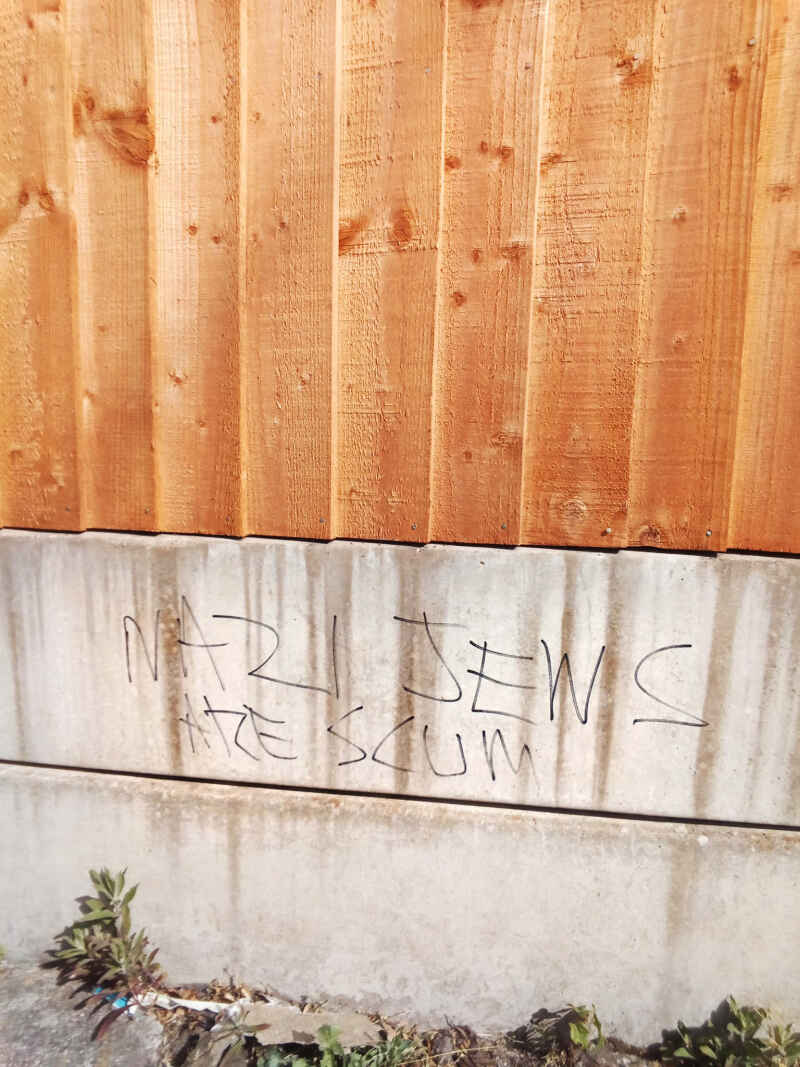
In May, a spate of antisemitic graffiti was recorded at several locations in north Manchester, including a kosher restaurant and a synagogue. The perpetrator wrote "NAZI JEWS ARE SCUM" on the facades of these buildings.
Threats
This category includes only direct antisemitic Threats, whether verbal or written. This would include potential improvised explosive devices (IEDs) that were designed to be hoaxes rather than IEDs that are intended to be viable.
CST recorded 196 direct antisemitic Threats in 2025, the third-highest annual total in this category, falling by 22% from the 251 incidents of this kind reported in 2024. Three hundred and fifteen incidents were recorded for this category in 2023, 103 in 2022, and 143 in 2021.
Fifty-one of the 196 Threats took place in public, while threats were directed at synagogues in 21 instances and, on five occasions, at congregants on their way to or from a prayer service. Jewish businesses and organisations – one of which was a youth camp – were targeted in 19 cases. Meanwhile, Jewish people were threatened while at home in 12 instances, public figures were threatened in seven incidents, and there were four Threats made in the sphere of higher education. Eight direct Threats were made to Jewish schools, five within the confines of non-faith schools, and three to Jewish pupils on their commute to or from their place of education. Sixty-five of the incidents in this category involved written threats in online platforms, 28 were delivered via phone call or voice message, two via post, and there were 14 bomb threats made.14
CASE STUDY:
Threatening email sent to Jewish newspaper
In October, a Jewish news outlet based in London received a threatening email. It read:
“The idea that you need a specific magazine for White people who enjoy raping and eating babies seems childish to me.
I feel like maybe I’m [in] your next life you will kick yourself for being Genocidal Nazi F*ggots
I’m going to make sure that you and all of your ancestors suffer
Kind Regards”
Abusive Behaviour
Within the umbrella of Abusive Behaviour falls a wide range of incident types, including everything encompassed by verbal and written antisemitic abuse other than direct threats. The category also includes antisemitic emails, text messages, social media posts and comments, as well as targeted antisemitic letters (that is, one-off letters aimed at and sent to a specific individual), irrespective of whether the recipient is Jewish. This is different from a mass mailing of antisemitic leaflets, pamphlets or group emails, which is dealt with by the separate Literature category. The verbal abuse can be face-to-face or via telephone calls and voicemail messages. Antisemitic graffiti on non-Jewish property is also included in this category.
There were 3,086 incidents reported to CST in the category of Abusive Behaviour in 2025, comprising 83% of the 3,700 annual total and signalling a rise of 6% from the 2,917 instances of Abusive Behaviour recorded in 2024. These 3,086 incidents are more than the overall figures recorded across all categories in every year besides 2024 and 2023. There were 3,493 incidents of Abusive Behaviour in 2023, 1,339 in 2022, and 1,849 in 2021.
In 532 of the Abusive Behaviour incidents reported in 2025, the victims were Jewish people in public, and identifiably so in at least 338 cases. Jewish organisations and businesses were targets of 469 incidents in this category, while public figures – Jewish and non-Jewish – were subjected to antisemitic abuse on 254 occasions. One hundred and sixty-three of these incidents were related to the synagogue sector, 151 to the school sector, and 65 to the university sector. On 101 occasions victims were harassed in their own homes, and in the workplace on 44 occasions.
CASE STUDY:
Abuse at gym in Manchester
In October, a man was witnessed ranting about Jewish people at a gym in northern Manchester. In the changing room, he was heard saying, “It’s all a put-up job it’s a lie, put up job by the Jews”. Then, as he was leaving the building, he shouted at the manager, “You do not own anything, the Jews own everything, it’s all owned by the Jews”.
Among the 3,086 incidents of Abusive Behaviour, 969 involved spoken abuse and 1,581 written abuse, while 172 contained generally threatening or intimidating language without making a direct threat. There were 411 cases of antisemitic graffiti, daubing, posters or stickers on non-Jewish property. Two hundred and seventy-eight of these cases of damage to non-Jewish property depicted a swastika or contained Nazi-era references, 146 were related to Israel and the Middle East, and counted among both these figures are 83 in which these discourses were combined. In 305 cases, anti-Jewish images, memes or cartoons were used to cause offence. Two hundred and seventy-seven incidents in this category involved offensive shouts or gestures in public, 201 of which emanated from passing vehicles. There were 59 counts of one-off hate mail that were not known to be part of a mass mailing, and 47 abusive phone calls or voice messages made.
Of the 3,086 reports in this category, 1,459 occurred online, constituting 47% of the category’s total and 95% of the 1,541 online incidents recorded across all categories. The record annual total for online antisemitic abuse, and the record percentage it comprises of all incidents logged across the year, emphasise the power of social media and instant messaging platforms in the production, spread and amplification of anti-Jewish hate in the modern world. They serve as facilitators of community, where antisemites can find other like-minded individuals who affirm their prejudice and encourage its propagation. On these virtual fora, they can easily project their hatred as far as they want, with the protection of total anonymity should they so desire.
The impact of cyber-based antisemitism is unquantifiable, but it is not limited to the online world. Every abusive post, comment, message, meme and video bears the potential to incite and inspire offline anti-Jewish activity. They dilute the taboo against publicly demonstrating hatred towards Jewish people, and when this taboo is perceived to be vanishing, antisemitism will happen with more regularity both online and offline. The proliferation of information and misinformation, and of angry online debate regarding Israel and the Middle East, are intrinsically linked to the sustained high levels of anti-Jewish hate in the UK since 7 October 2023. Of the 1,541 online instances of antisemitism reported to CST in 2025, 1,080 (70%) were Israel-related (while also showing anti-Jewish language, motivation or targeting), compared to 42% of offline incidents.
Literature
This category covers mass-produced antisemitic literature that is distributed in multiple quantities. This can involve a single mass mailing or repeated individual mailings, but it must involve the multiple use of the same piece of literature in order to fall into this category. This is different from one-off cases of hate mail targeted at individual people or organisations, which would come under the category of either Abusive Behaviour or Threats. This category includes literature that is antisemitic in itself, irrespective of whether or not the recipient is Jewish, and cases where Jews are specifically targeted with malicious material, even if the content itself is not antisemitic. This would include, for instance, the mass mailing of neo-Nazi literature targeted at Jewish organisations or homes, even if the literature did not mention Jews. This category also includes antisemitic emails and online posts that are sent to groups of recipients. The statistics for this category give no indication of the extent of distribution. A single mass mailing of antisemitic literature is only counted as one incident, although it could involve material being sent to dozens of recipients. Thus, the number of incidents reflects the number of offenders and their actions, rather than the number of victims.
There were 27 incidents reported to CST in this category in 2025, equal to the 27 incidents of this type recorded in 2024. CST recorded 22 instances of Literature distribution in 2023, nine in 2022, and ten in 2021.
In eight of the antisemitic incidents recorded in this category in 2025, public walls were reported to have been plastered with mass-produced antisemitic posters, four of which were produced and distributed by far-right group the Goyim Defence League (GDL). On eight occasions, the offender spammed synagogues, rabbis and Jewish organisations with antisemitic emails. In two cases, anti-Israel hate mail was posted to synagogues, and there were two examples of a different identical conspiratorial letter posted at personal addresses. In two separate instances, Jewish public figures and institutions were spammed with an identical abusive comment on X; on one occasion, several university chaplains received an email filled with antisemitic and anti-Muslim conspiracy theories and stereotypes. There was one example of a far-right newspaper posted to Jewish properties in a Greater Manchester neighbourhood, one report of a book with antisemitic poetry handed out on a walking tour, one of a church newsletter showing support for Hamas and comparing Israel to the Nazis, and one incident involving a leaflet equating Zionists with Nazis at a demonstration for Palestine.
CASE STUDY:
Antisemitic book on walking tour
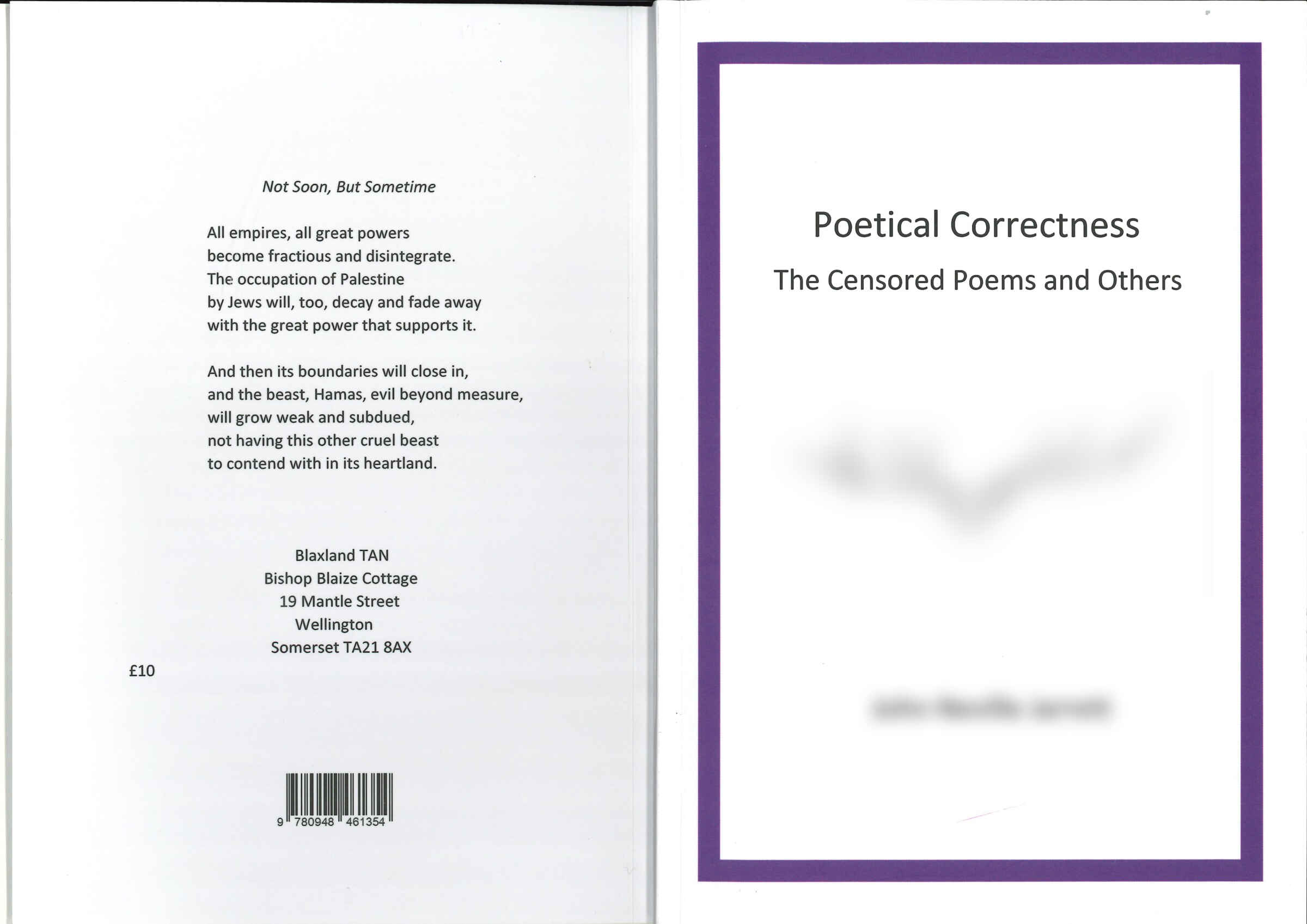
In October, attendees on a walking tour in Somerset were handed a poetry book. Within it, there were poems titled ‘Troublesome Jews’, ‘The Second Holocaust’ and ‘The Terrorists We Rewarded’, pictured below.
Incident victims
The victims of antisemitic incidents come from the whole spectrum of the Jewish community: from strictly orthodox to liberal, reform and secular Jews; from the largest Jewish communities to small, isolated communities across the UK; from Jewish schoolchildren to Members of Parliament. Occasionally, antisemitism will also be directed at people who do not identify as Jewish.
There were 741 incidents reported to CST in 2025 in which the victims were ordinary Jewish individuals in public. In at least 459 incidents, they were visibly Jewish on account of their traditional clothing, Jewish school uniforms, jewellery, insignia or other items bearing religious symbols, or their presence at public Jewish events. In 2024, this was the case in 951 and 495 incidents respectively. There was an element of spoken verbal abuse in 1,216 of the 3,700 incidents recorded by CST in 2025, 195 of which incorporated threatening language. In 324 cases, anti-Jewish hate was shouted or gestured by random strangers in public who, on 238 occasions, did so from a vehicle. These modus operandi are representative of the most common type of in-person incident reported to CST since the organisation began compiling data on anti-Jewish hate: the random, unprovoked, verbal or gestured harassment of individuals who are presumed for whatever reason to be Jewish, as they go about their daily lives in public.
Of the 1,216 instances of verbal abuse recorded in 2025, the phrase “Free Palestine” was shouted in at least 210, targeting random Jewish people in public on 148 occasions. This phrase is not in itself an antisemitic expression and would not, in isolation, be treated by CST as an antisemitic incident. However, in these circumstances, it was specifically used to harass Jewish people and organisations for no other reason than their perceived Jewishness. “Free Palestine” in that momentary context takes on the role and purpose of an antisemitic slogan, a tool with which to intimidate a target because of their imagined or actual Jewish identity.
In 2025, there were 57 antisemitic incidents recorded at Jewish schools, compared to 63 in 2024. An additional 70 incidents involved Jewish schoolchildren away from school premises, usually on their way to or from home, compared to 89 in 2024. CST recorded 77 incidents involving Jewish schoolchildren or staff at non-faith schools, falling from 114 in 2024. This results in a total of 204 incidents affecting people and buildings in the school sector, a decrease of 23% from the 266 such incidents reported in 2024. While antisemitic incidents in this sector were not as common as they were in 2024 or 2023 (335 reports), they still happened at a higher rate than typically recorded before 7 October. In 2022, the last full year in which UK-based anti-Jewish hate was not majorly impacted by a trigger event in the Middle East, CST recorded 98 school-related incidents.
Of the 204 incidents targeting schools, pupils and staff, 28 came under the category of Assault, 21 of which involved Jewish schoolchildren attacked on their commute, six saw Jewish schoolchildren targeted by their classmates at non-faith schools, and one attack targeted schoolchildren as they were leaving the premises of their Jewish school. Nine incidents were classed as Damage & Desecration to Jewish property; there were 16 direct Threats made (eight to Jewish schools, five to Jewish pupils at non-faith schools, and three to schoolchildren on their way to or from school); and there were 151 incidents classed as Abusive Behaviour. It is alarming that physical attacks account for 14% of incidents in the school sector, but just 4% of reports from other environments. It correlates with the concerningly high percentage of children involved both as victims and perpetrators of antisemitic violence, as covered in the Incident Categories chapter of this report.

In higher education, CST also logged a decrease in incidents of anti-Jewish hate. In 2025, 78 antisemitic incidents affected Jewish students, academics, student unions or other student bodies, or were perpetrated by individuals in the university sector. It is a fall of 41% from the 133 such incidents recorded in 2024. Of these 78 incidents, two were serious enough to be classed as Extreme Violence, three were classified as Assault, two as Damage & Desecration, four as Threats, 65 as Abusive Behaviour, and two as Literature. Thirty-nine of them took place on campus or university property and 39 away from campus, of which 25 were online (down from 68 and 65 respectively in 2024).
Fifty-six (72%) of these 78 incidents were overtly related to Israel and the Middle East, while also demonstrating anti-Jewish hate or motivation. This proportion is significantly higher than amongst incidents that did not occur in the context of university life, where 53% of incidents showed this kind of discourse. This disparity cannot be explained by a single reason, but the longstanding tradition of anti-Israel student activism may be relevant to this discrepancy. It may contribute to an environment in which some individuals express strong anti-Israel views through antisemitic language, or direct this activism unreasonably at Jewish students simply because they are Jewish. The frequent equation of Israel’s alleged actions to the Holocaust (made in 14 incidents in the university sector in 2025) is part of this phenomenon.
There were five antisemitic incidents recorded in 2025 that targeted Jewish cemeteries and 177 that impacted synagogues (including buildings, congregants and staff while at the location), exceeding 2024’s total of 163 by 9%. A further 50 incidents saw prayer-goers targeted on their way to or from services, down by 15% from 59 incidents of this kind reported in 2024. This constitutes a record annual total of 227 synagogue-related incidents, a net rise of 2% from 2024’s figure of 222 such cases.
The most severe of the 177 incidents affecting synagogues and their congregants and staff was, of course, the terrorist attack at Heaton Park Synagogue in Manchester, which was logged as an incident of Extreme Violence. Seven of these reports fell into the category of Assault (six targeting Jewish people on their way to or from services and one on synagogue grounds), while 25 involved the Damage & Desecration of synagogue property. There were 26 direct Threats made (21 to Jewish places of worship and five to congregants in public), 163 cases classified as Abusive Behaviour, and five as Literature. A synagogue is a place of Jewish prayer and communal activity, and the most visible symbol of a Jewish life in any neighbourhood. As such, an attack on a synagogue is not a political statement against Israel, but an assault on Jewish life in the UK. It is hugely significant and revealing that, although there is evidence that Jihad al-Shamie, the perpetrator of the Heaton Park attack, was at least partly motivated by Islamist extremist ideology and anger towards Israel, a synagogue and its congregation were chosen as the target for the most lethal attack on British Jews recorded since CST began compiling data on antisemitic incidents.
An annual record of 48 incidents were related to the workplace, rising by 45% from the 33 reports of this kind in 2024. Meanwhile, 512 incidents targeted Jewish businesses and organisations – including youth movements on five occasions – a fall of 22% from the 653 such cases in 2024, the only year in which more were reported. Public figures were targeted with anti-Jewish hate in record numbers, with 263 such incidents recorded in 2025, 47% higher than the previous yearly record of 179 such incidents logged in 2024.
The high levels of anti-Jewish hate reserved for Jewish institutions and high-profile individuals – Jewish and non-Jewish – reflect the way they are held responsible for events in the Middle East, particularly online. In some cases, they are accused of malevolent collusion, buying British politicians, selling their political integrity to Israel, or influencing decisions that impact the region. These myths draw on well-established antisemitic ideas of Jewish control over society, with money their favoured vessel through which to wield it. Of the 512 cases of antisemitism directed at Jewish organisations, 429 (84%) occurred online, 410 (80%) contained Israel-related rhetoric, and 114 (22%) contained allegations of disproportionate Jewish power in the world. This was respectively true of 231 (88%), 234 (89%) and 74 (28%) of the 263 incidents impacting public figures in 2024.
These high levels are also indicative of the vitriol received when Jewish organisations and people of public prominence speak on the topic of anti- Jewish hate in reaction to world events. Of the 512 instances of antisemitism reported wherein a Jewish institution was a victim, 12 occurred on 29 June, the day after punk-rap group Bob Vylan chanted “Death to the IDF” at Glastonbury Festival; 22 occurred across 2 and 3 October, the day of and day following the terror attack on Heaton Park Synagogue, which were the two worst days for antisemitic incidents throughout the year (with 40 reported on each); 12 occurred across 14 and 15 December, the day of and day following the terror attack on Bondi Beach. Taken together, these five days totalled 9% of all incidents affecting Jewish organisations in 2025, largely in response to their public statements in the immediate aftermath of these three significant events. This same pattern affected public figures speaking out about antisemitism, with 13 cases of anti-Jewish hate directed at them on 1 July following events at Glastonbury, and 19 on 2 and 3 October after the terror attack on Heaton Park. These comprised 12% of all incidents with high-profile victims.15 CST did not note a spike in incidents targeting public figures in the wake of the Bondi Beach terror attack.
In 2025, 191 incidents reported to CST occurred at people’s residential property or affected their parked vehicles, more than in any other year. This is a rise of 15% from 166 incidents of this kind reported in 2024.
Fifty-six of these were perpetrated by a neighbour or somebody with a prior relationship to the victim, forming part of the 223 cases of antisemitism wherein the offender was known to the victim prior to the incident. It is a decrease from the 243 such instances of “interpersonal” hate recorded in 2024 and comprise 6% of the overall figure.
There were 36 antisemitic incidents reported to CST in 2025 that were in some way related to professional football, rising by 44% from 25 such incidents recorded in 2024. Of these, five involved anti-Jewish hate observed within a stadium, four in a non-stadium environment, and 27 were online incidents. Fourteen of these 36 incidents were antisemitic comments made in relation to West Midlands Police’s decision to ban Maccabi Tel Aviv supporters from attending a match against Aston Villa in November 2025 (13 online and one in person). CST recorded a further ten incidents in the context of grassroots or amateur football, falling from 17 incidents of this kind in 2024. There were two additional reports of antisemitism that occurred at amateur level in other sports: one in a rugby match, and one at a school sports day.
CST received a description of the victims’ gender in 1,728 of the 3,700 antisemitic incidents recorded in 2025. Of these, 971 (56%) were male; 527 (31%) were female; and in 229 incidents (13%), the victims were mixed groups of males and females. In one incident, the victim identified as non-binary.
The victim or victims’ age was ascertained in 1,727 of the antisemitic incidents reported to CST in 2025. Of these, 1,421 (82%) involved adult victims, of which 44 cases involved adults over the age of 65; 207 (12%) involved victims who were minors; in 99 instances (6%), mixed groups of adults and minors were targeted. Alarmingly, of the 306 incidents in which children were amongst the victims, 57 (19%) involved physical attacks, whereas of the 1,520 incidents with adult victims, 108 (7%) were acts of violence.
Incident offenders
It is not always easy to ascertain the ethnicity, gender or age of antisemitic incident offenders. Many face-to-face incidents involve fleeting, nonverbal, public encounters in which the offenders may not be fully visible or leave the scene quickly. Victim and witness testimonies may be vague and disjointed, which is understandable given the nature of the ordeal that they have experienced. Many incidents do not involve face-to-face contact, and it is therefore not always possible to obtain a physical description of the perpetrator. Furthermore, those who commit antisemitic offences online may choose to completely anonymise themselves, which makes it almost impossible to garner any information about the person behind the abuse. On the other hand, if social media profiles are not anonymised, they can provide some personal details of offenders, such as a name, photograph or approximate location.
While it is possible to collect data regarding the ethnic appearance of incident offenders, this data is not direct evidence of the offenders’ religious affiliations or political beliefs. The content of an antisemitic letter may reveal the motivation of the offender, but it would be a mistake to assume the ethnicity or religion of a hate mail sender solely on the basis of the discourse they employ.
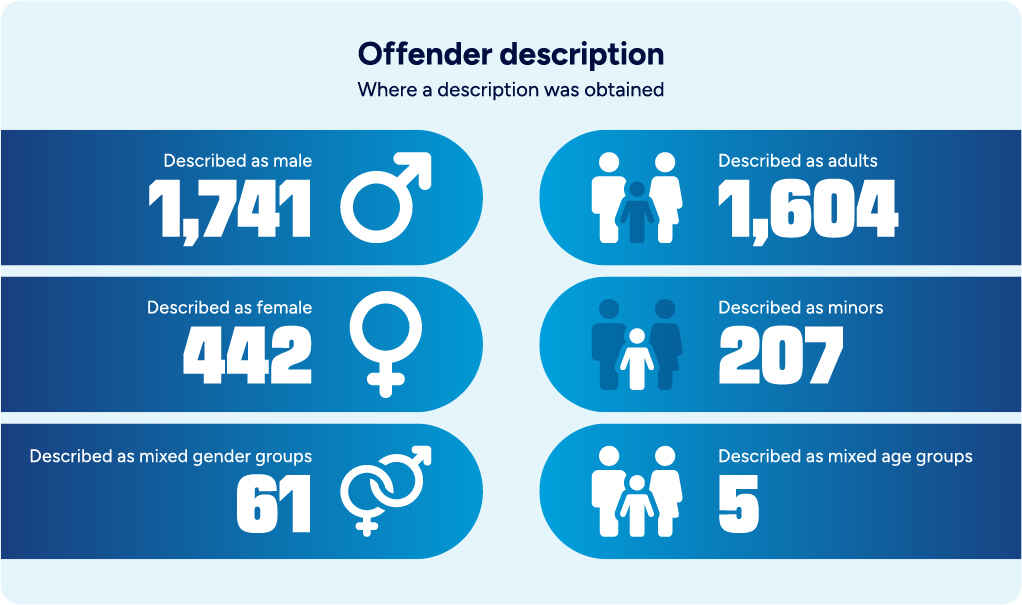
CST received a description of the ethnic appearance of the offender or offenders in 1,385 of the 3,700 antisemitic incidents recorded in 2025. Of these, 714 (52%) were described as white – North European; 38 (3%) as white- South European; 123 (9%) as black; 160 (11%) as South Asian; six (<1%) as Southeast Asian; and 344 (25%) as Arab or North African. Although 2025 was a year in which anti-Jewish discourse was heavily impacted by events in the Middle East, these percentages signal a partial return to the breakdown of perpetrator ethnicities typical of periods less affected by wars involving Israel. While the proportion of offenders described as Arab or North African remains elevated from this norm (although less than the 28% reported in 2024), it is the first time since 7 October 2023 that perpetrators described as white – North European form the sole majority within this data. It is important to bear in mind that these details rely on the subjective judgement of witnesses and victims, made in what can be brief, disorientating encounters.
A description of the gender of the offender or offenders was obtained in 2,244 of the 3,700 antisemitic incidents reported in 2025. Of these, the offenders were described as male in 1,741 incidents (78% of incidents where the offender’s gender was obtained); female in 442 incidents (19%); and mixed groups of males and females in 61 incidents (3%). This proportional breakdown is consistent with those reported in 2024 and 2023, but differ from those recorded the year before. In 2022, 82% of incidents had a male offender, 16% a female offender, and 2% mixed groups of males and females. This may be another – albeit curious – manifestation of the impact of war in the Middle East on UK-based anti-Jewish hate. Of the 442 cases of antisemitism exclusively perpetrated by females, 328 (74%) contained discourse referencing Israel, Palestine and events in the region, while 301 (68%) showed explicit anti-Zionist motivation. For incidents with exclusively male offenders, this was true of 944 (54%) and 829 (48%) cases respectively. There is no clear reason why women might be more likely than men to incorporate anti-Israel or anti-Zionist language in their antisemitic hate speech in the incidents recorded by CST.
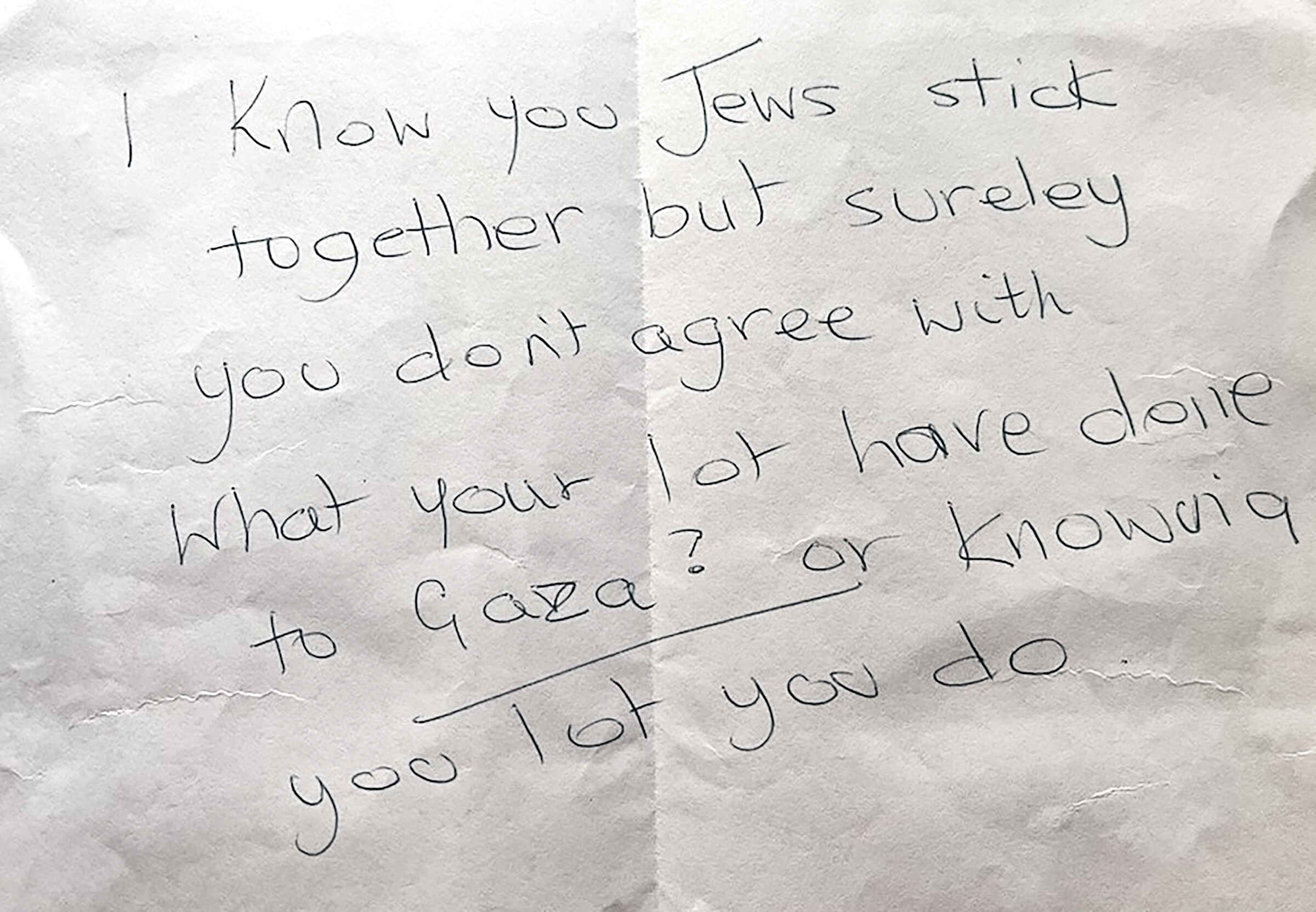
In 1,816 of the 3,700 reports of antisemitism in 2025, the approximate age of the offender or offenders was given. Among them, 1,604 (89%) involved adult offenders, 56 of which were perpetrated by adults described to be over the age of 65; in 207 cases (11%), the perpetrators were minors; and there were five instances (<1%) where the offenders were a mix of adults and children. There has been a decrease in the quantity and percentage of antisemitic incidents perpetrated exclusively by minors from 2024, when CST logged 310, 17% of the 1,874 reports for which a description of the perpetrators’ age was received. This fall correlates with the reduction in school-related antisemitism recorded in 2025.
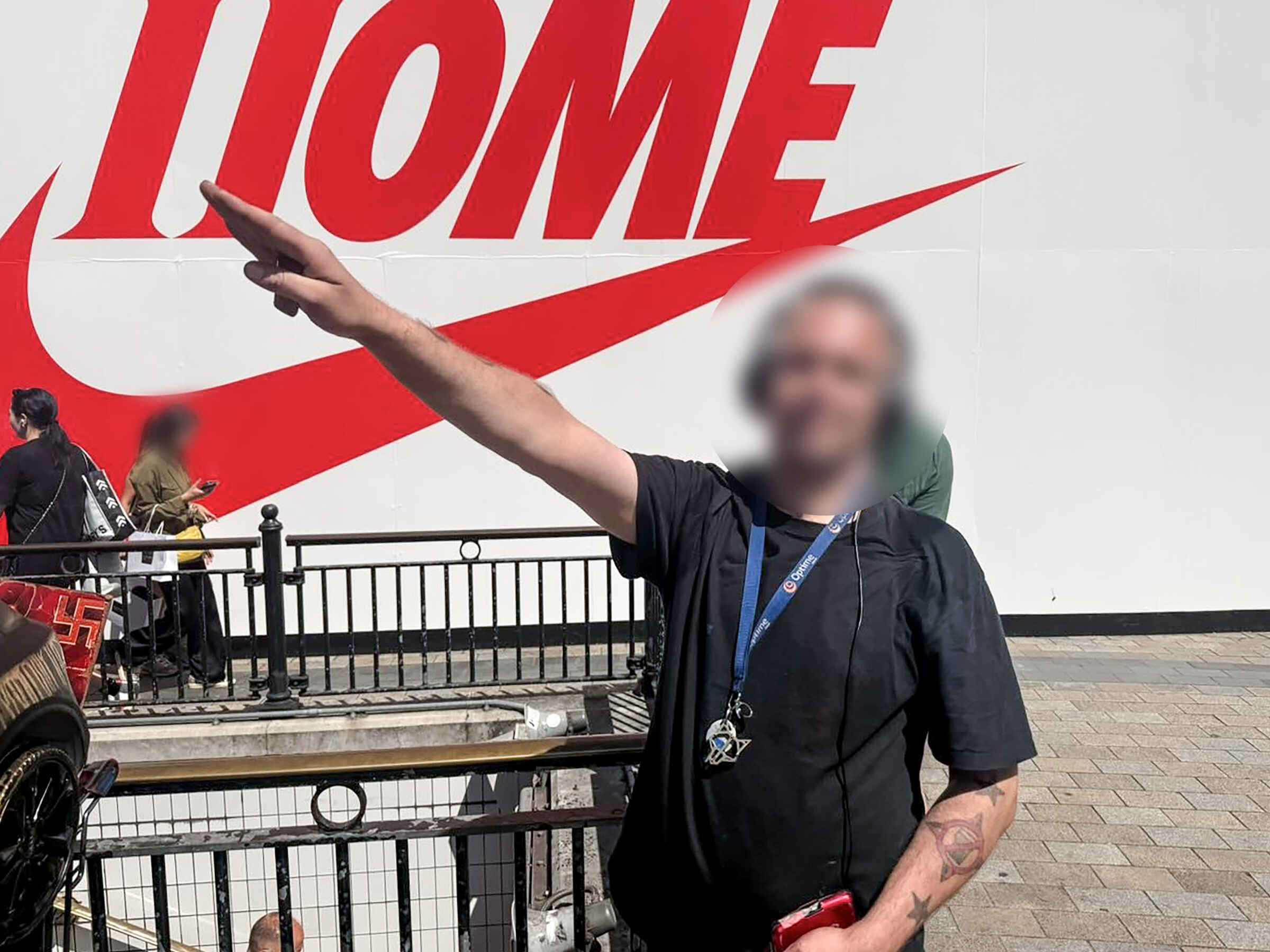
Antisemitic or anti-Israel
CST is often asked about the difference between antisemitic incidents and anti-Israel activity, and how this distinction is made in the categorisation of incidents. The distinction between the two can be subtle and the subject of much debate. Clearly, it would not be acceptable to define all anti-Israel activity as antisemitic. Nevertheless, it cannot be ignored that contemporary antisemitism can occur in the context of, or be accompanied by, extreme feelings over the Israel/Palestine conflict, and that hostility towards Israel may be expressed via, or motivated by, anti-Jewish rhetoric, stereotypes and conspiracy theories. Discourse relating to the conflict is used by antisemitic incident offenders to abuse Jews, and anti-Israel discourse can sometimes repeat, or echo, antisemitic language and imagery. For example, the terms “Zionist” and “Zionism” will often be used in arguments about Israel and the Middle East; sometimes they are used accurately and legitimately, and at other times they are deployed in an antisemitic way. CST must distinguish between the occasions when these terms are used in a purely political sense, and the times when they are abused as euphemisms for “Jews” and “Jewishness”, or demonised using traditional anti-Jewish tropes. Similarly, the phrases “Zionist Lobby” and “Israel Lobby”, when they are deployed indiscriminately as a label for Jewish organisations and individuals regardless of whether they are relevant to the matter being discussed, connect the conspiracy theory that Jews have a disproportionate political power and influence, with the antisemitic trope that Jews are disloyal and not to be trusted. Drawing out these distinctions, and deciding on where the dividing lines lie, is one of the most difficult areas of CST’s work in recording and analysing hate crime.
Sometimes the targeting of a particular incident can suggest an intention to intimidate or harass Jews on the part of the offender. For example, if anti-Israel posters or graffiti appear to have been deliberately placed close to a synagogue or other Jewish building, or in an area with a large Jewish population, then they are more likely to be classified as an antisemitic incident than if they are placed in a more general or neutral location. If anti-Israel material is sent unsolicited to a synagogue or other clearly Jewish venue at random then it may well be recorded as an antisemitic incident (because the synagogue was targeted on the basis of it being Jewish and the offender has failed to distinguish between a place of worship and an organisation involved in pro-Israel political activity). Similarly, if cars draped in Palestinian flags are deliberately driven through the heart of Jewish communities, or shouts of “Free Palestine”, or comments and questions demanding an opinion on the Middle East are directed at Jewish people – simply because they are perceived to be Jewish – it will also be considered an antisemitic incident.
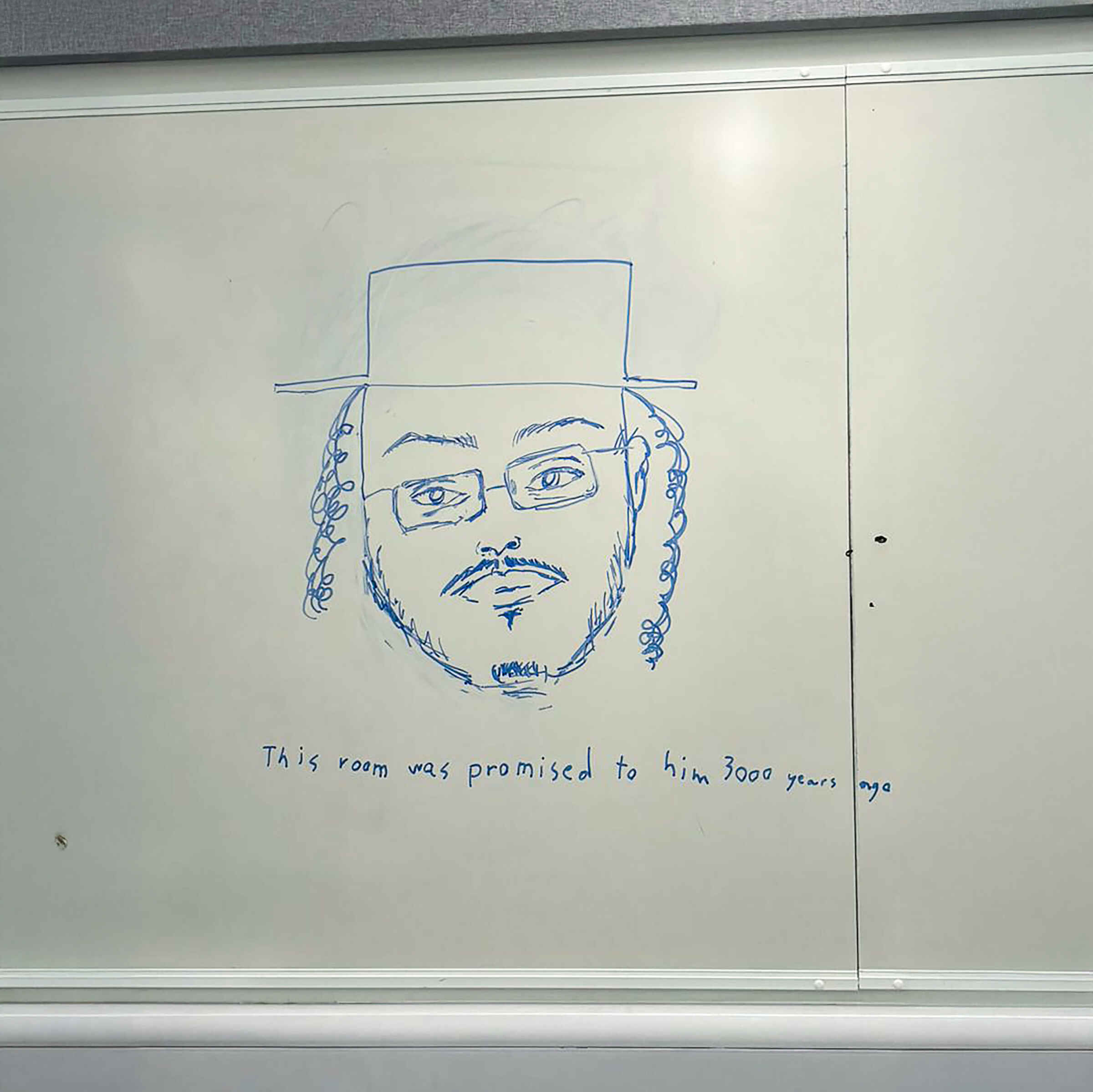
If, however, anti-Israel material (containing no antisemitic language) is sent unsolicited to specifically pro-Israel organisations, then this incident would not be classified as antisemitic. Similarly, if a Jewish individual or group engaging in public pro-Israel advocacy subsequently receives anti-Israel material, comments or questions, this would most likely not be classified as antisemitic (unless, again, it contains antisemitic language).
The political discourse used in an incident may also be the reason why the incident is or is not considered antisemitic. In particular, incidents that equate Israel to Nazi Germany would normally be recorded as antisemitic because the comparison is so deeply hurtful and abusive, using Israel’s self-definition as a Jewish state as the basis for the insult. This analogy, made in increasing quantities since 7 October 2023, is reflected in changes to anti-Jewish language, such as in the neologism “Zionazi”. However, incidents that compare Israel to, for example, apartheid South Africa, would not normally be recorded as antisemitic incidents, nor would claims that Israel has committed a genocide in Gaza (unless allusions are directly made to the genocide carried out by the Nazis). While the charges that Israel practises apartheid or carries out genocide upset many, they differ from the comparison with Nazism, which carries particular meaning for Jewish people because of the Holocaust; nor do they play directly on Israel’s Jewishness as a way of causing hurt.
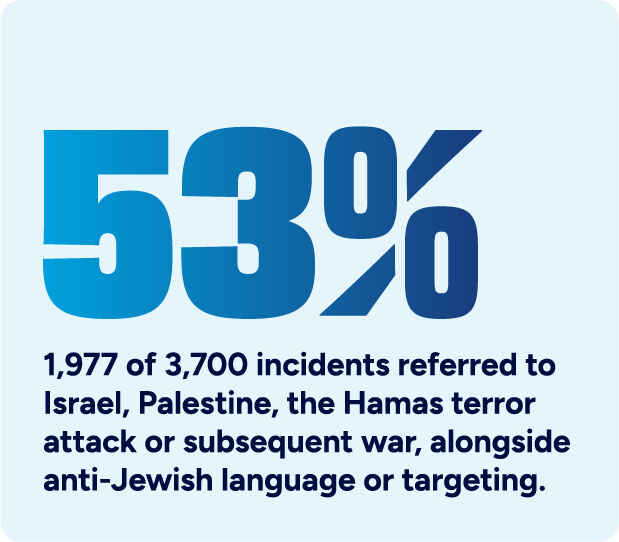
CST recorded 1,977 antisemitic incidents that alluded or were related to Israel and the Middle East in 2025. There were 1,766 reports in which the offender demonstrated outright anti-Zionist motivation that went beyond more superficial discourse about the region or the conflict, alongside explicitly anti-Jewish comments or abuse aimed at unsuspecting Jewish people. Variations on the terms “Zionism” or “Zionist” were employed in 462 cases of anti-Jewish hate, while 387 included a comparison between Israel and the Nazis.
Irrespective of whether or not anti-Israel incidents are classified as antisemitic by CST, they are still relevant to CST’s security work as they may involve threats and abuse directed at Jewish people or organisations who work with – or in support of – Israel, and therefore have an impact on the security of the UK Jewish community.
Discourse, motivation and ideology
CST attempts to assess the number of antisemitic incidents that take place in the UK each year within which there is evidence of political, religious, or ideological discourse or motivation. CST also monitors the number of instances where conspiracy-fuelled sentiments are present. Stereotypical tropes about the Jewish people’s power, influence, and money – and claims that the tragedies of the Holocaust are exaggerated or invented – can be especially prevalent in online expressions of antisemitism. It is common for two or more of these discourses to exist within the same incident, even if they would seem ideologically incompatible. Such apparent contradictions perfectly capture the multifaceted nature of contemporary anti-Jewish hate. In total, 2,821 (76%) of the 3,700 antisemitic incidents recorded by CST in 2025 contained one or more political or ideological discourses or motivations. They were present in 2,610 (73%) out of 3,556 incidents in 2024, 2,731 (64%) of 4,298 in 2023, and 834 (50%) of 1,662 in 2022. This proportional increase in political, ideological and conspiratorial language and motivations during the last three years is another indicator of the cumulative impact that war in the Middle East has had on the language of antisemitism in the UK.
Historic, simplistic prejudices have been manipulated and deployed by such a vast array of social, religious, cultural and political forces over such a long period of time, that a complex and layered landscape of antisemitic language, imagery and references has emerged. Partly as a consequence of this, the use of a certain rhetoric does not necessarily evidence a specific motivation or allegiance: for example, a person who shouts “Heil Hitler” at a Jewish passer-by might align themselves with far-right extremist ideology, or they might simply know that this phrase will cause upset and offence to Jewish people. Similarly, someone who shouts “Free Palestine” at people walking to synagogue may be a staunch campaigner for Palestinian liberation, or perhaps they just consider it another weapon in their rhetorical arsenal to deploy against Jews.
Israel-related antisemitism
In 2025, the most common discourse employed in antisemitic incidents referenced or was in some way linked to Israel, Gaza, the Hamas terror attack on 7 October 2023 or the subsequent war in the region (alongside anti-Jewish language or targeting). This rhetoric appeared in 1,977 (53%) of the 3,700 antisemitic incidents reported in 2025, a 7% rise from 1,855 such incidents recorded in 2024. Since 7 October 2023, the proportion of anti-Jewish hate concerned with this topic has risen. For comparison, these narratives were present in 52% of incidents logged in 2024, 43% in 2023 and 15% in 2022: the last year when the volume and content of antisemitism in the UK was not significantly impacted by events in the Middle East. This pattern is also evident in the percentages of incidents containing overtly anti-Zionist ideas alongside anti-Jewish hate speech or targeting. These were present in 1,766 reports of antisemitism in 2025 – 48% of the annual figure – compared to 43% of the total in 2024 (1,542 incidents), 31% in 2023 (1,353 incidents), and 9% in 2022 (149 incidents). It is interesting that the proportion of explicit anti-Zionism within the antisemitic incidents reported to CST has grown at a faster rate than incidents that are simply Israel-related. This may indicate that, since 7 October, not only has a generalised hatred of Israel become more present within manifestations and expressions of anti-Jewish hate, but that it has hardened into a fundamental rejection of Israel’s existence, entwined with hostility towards Jews in Britain. Meanwhile, variations on the words “Zionism” or “Zionist” were used in 462 cases, either as euphemisms for “Jewishness” and “Jew” or alongside other antisemitic language or imagery, an increase from 423 incidents of this kind in 2024, 271 in 2023 and 80 in 2022.
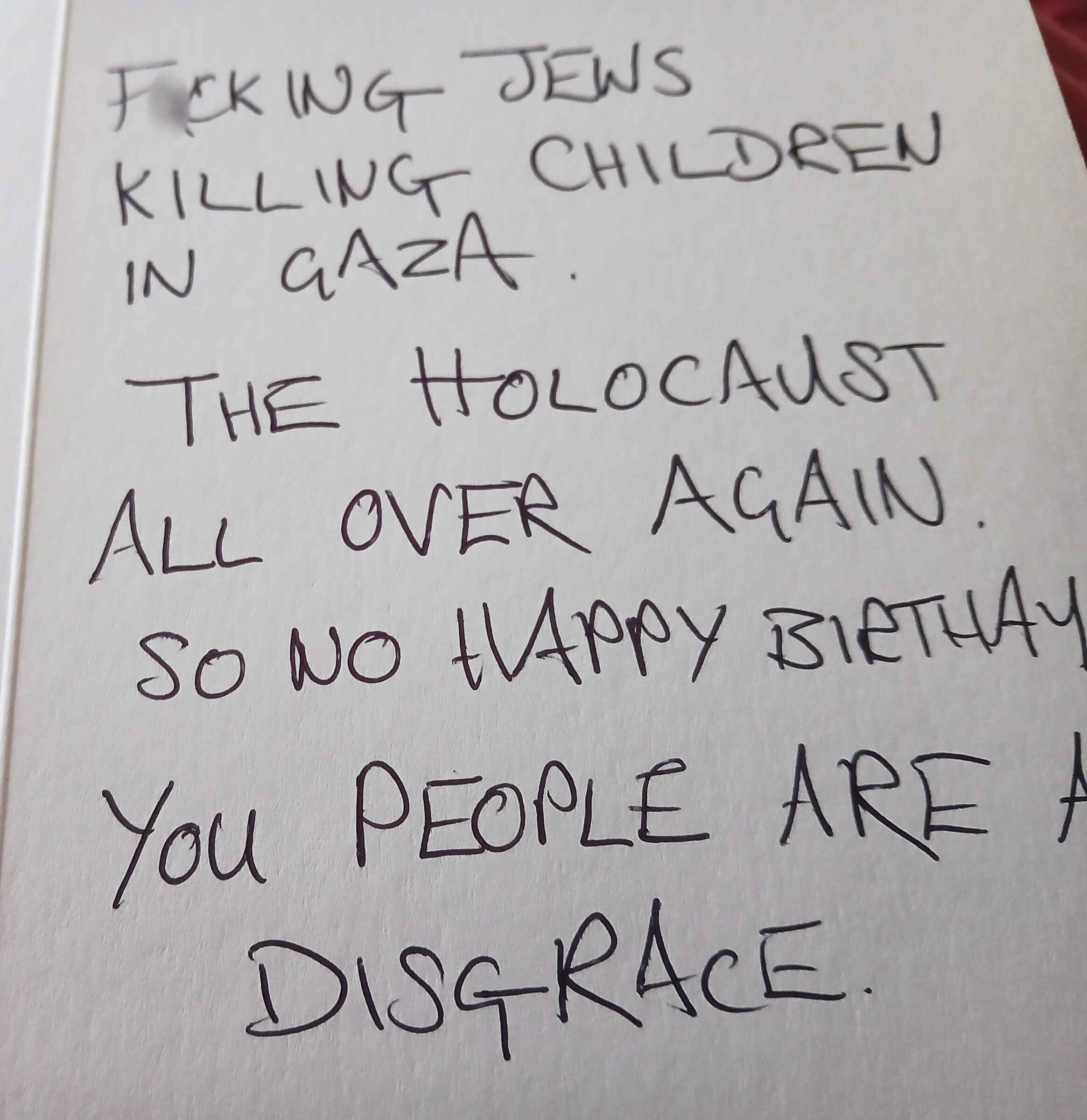
Holocaust-related antisemitism
In 984 incidents – 27% of the 3,700 antisemitic incidents reported to CST in 2025 – the offender or offenders alluded to Hitler, the Nazis, the Holocaust, used rhetoric associated with the period of Nazi rule, and/or punctuated their abuse with a Nazi salute, the depiction of a swastika, or other related imagery. This is an increase of 7% from 2024, when 921 incidents – 26% of the annual figure – employed these references. Nazi-related language and symbols have historically been the most prevalent discourse in anti-Jewish hate in the UK during periods when antisemitism is not affected by Israel-related trigger events, and remain significant reference points for antisemites during periods when it is. Fifty of these 984 incidents involved minimisation of the scale of the Holocaust or denial that it happened at all, falling by 19% from 62 such incidents in 2024. In 207 of these 984 reports, the Holocaust, its perpetrators and/or their ideas were glorified, or the desire for its repeat was expressed, a rise of 47% from 139 in 2024 and more than four times the number of Holocaust denial incidents. Of these 207 incidents, 66 (32%) were also Israel-related. In these reports, offenders claimed that Israel has shown Hitler to be right about the Jews, wished for another Holocaust to put an end to Israel and Zionism, or lamented his failure to fully wipe out the Jewish population and thereby prevent Israel’s existence. On 13 occasions, the perpetrator simultaneously denied and venerated the Holocaust, a contradiction that encapsulates how confused and blurred antisemitic ideas can be in the minds of people who hate Jews. In 290 of these 984 incidents involving Nazi-related hate speech, the abuse was graffitied, daubed, scratched, stuck or printed on public or private property, usually including the graphic of a swastika. There were 253 cases wherein the offender’s far-right allegiance or political motivation were identified, 130 of which were accompanied by Nazi-era allusions, increasing from 176 and 105 such incidents respectively in 2024.16 Meanwhile, there were 387 incidents in which a direct comparison was made between Israel, Israelis or Jewish people and Nazi Germany or the Nazis, rising from 333 such instances in 2024, 257 in 2023 and 32 in 2022. Cases in which offenders drew this parallel are counted among both the totals for Israel- and Holocaust-related rhetoric, bridging the two most popular discourses employed by antisemites in 2025.
Religiously motivated antisemitism
CST recorded 136 antisemitic incidents in 2025 that contained discourse relating to Islam, Muslims, and Islamist groups, falling from 157 such incidents in 2024. Twenty-eight of these incidents showed evidence of extreme right-wing ideology and were simultaneously derogatory towards Muslim and Jewish communities. In 39 cases, Islamist extremist ideology was present, decreasing from 65 in 2024. Of these 39 Islamist extremist incidents, 29 were related to the Middle East, either demonstrating militant support for Hamas and the 7 October terror attack or advocating for similar events in the future (alongside anti-Jewish language or targeting). Still, the decrease in Islamist extremist ideology present in anti-Jewish hate in 2025 may indicate that, while rhetoric mentioning Islam still remains more prevalent in antisemitism than it was prior to the 7 October attack, this particular type of extremist language has partially subsided over the course of the past year. An additional 61 reports of anti-Jewish hate featured another religious ideology, up from 55 in 2024. Twenty-nine of these were Israel-related, and most involved arguments that Jewish people, Zionism and/or Israel are antithetical to Christian values.

Conspiracy theories
Antisemitic conspiracy theories were evident in 666 (18%) of the 3,700 antisemitic incidents reported in 2025, marking an increase in number and proportion from the 489 such incidents recorded in 2024, 14% of that annual figure. Of these, 467 alleged Jewish power over global politics, media, finance and other industries (compared to 347 in 2024); 174 spread falsehoods about religious practices, such as worshipping Satan, ritual murder and the ‘Blood Libel’ charge (up from 108 in 2024); while 18 involved conspiratorial myths regarding the origins of Jews and Jewishness in attempts to undermine the legitimacy of any concept of modern Jewish identity (a rise from 15 incidents of this nature reported in 2024).
Antisemitism targeting customs and texts
Specific aspects of Judaism were attacked or deliberately mischaracterised for antisemitic purposes in 117 instances, more than the 101 such incidents recorded in 2024. Sixty-two manipulated ideas and stories taken from religious scripture (compared to 46 reported in 2024); 29 focused on religious literature (falling from the 39 in 2024 that targeted specific Jewish holy books); and 26 singled out religious traditions (a rise from 16 in 2024). In 395 cases, the antisemitism was littered with anti-Jewish stereotypes, caricatures, or dehumanising language and imagery, more than the 335 such examples in 2024. There were 19 examples of antisemitic abuse concerning specific ethnic groups that exist within the wider Jewish world, one more than the 11 such cases reported in 2024.
Politically motivated antisemitism
Antisemitic incidents are classified as connected to specific political parties based on the offender’s stated affiliation or support; because the abuse was targeted at, or expressed by, party members, activists or representatives; or because an incident appeared to be motivated by news stories related to that party. It is often not possible to ascertain whether the offenders are themselves party members or not; in some cases, they have been expelled from their former party but continue to express antisemitism in relation to it. These caveats mean that these totals are not indicators of the relative amounts of antisemitism within, or tolerated by, each political party. In 2025, 54 antisemitic incidents recorded by CST were politically motivated or linked to specific political parties or their supporters. This is a decrease of 23% from the 74 incidents of this kind reported in 2024, a year during which a General Election was called and held. Twenty of the 54 incidents of this type recorded in 2025 were associated with the Labour Party, 14 of which were Israel-related (a fall from 2024’s total of 50 Labour party-related incidents, when 39 referenced the Middle East); seven were connected to the Green Party, four of which targeted its Jewish leader Zack Polanski with abuse (a rise from one Green Party-related incident in 2024); seven antisemitic incidents were linked to the Reform Party (none in 2024); five to the Conservative Party (compared to two in 2024); two to the Socialist Workers Party (down from seven in 2024); one to the National Housing Party UK (equal to the total in 2024); one to independent parliamentary candidates and councillors (compared to seven in 2024); and one to each of the Alba Party, the British Democratic Party, the Communist Party of Britain, the Scottish National Party, the United Kingdom Independence Party, the Workers Party of Britain, and Your Party (none of which were linked to any antisemitic incidents reported in 2024).
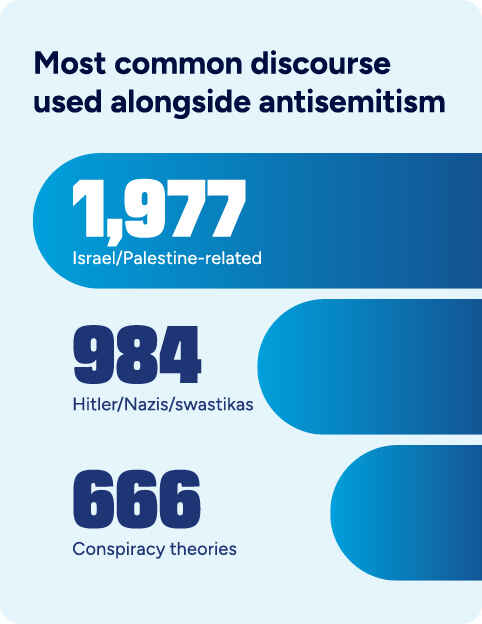
Thirty of the 54 politically motivated cases of anti-Jewish hate contained narratives relating to the Middle East, of which 11 alleged Israel, Jews or Zionists have control over British politics and policy makers.
It is not a surprise that Israel-related discourse dominated anti-Jewish hate incidents in 2025, appearing in over half of them. Since CST began recording incidents of antisemitism in 1984, spikes in antisemitism have been logged whenever Israel has been at war, and the language of this hatred has adapted to these contexts. In 2025, the topic of Israel and wars it was involved in across the Middle East, from Gaza to Lebanon and Iran, remained prominent in news and public debate, even throughout the various ceasefires agreed in the region over the course of the year. Anti-Israel demonstrations took place throughout 2025, as did marches against anti-Jewish hate and vigils for Hamas’ victims. The presence of antisemitism within parts of this anti-Israel movement has been codified within easily repeatable slogans which, when taken out of the context of ordinary protest and aimed at unsuspecting Jewish people, become tools of anti-Jewish abuse. The most popular of these is “Free Palestine”, which was used for antisemitic purposes in at least 289 incidents in 2025, whether spoken or as written text. While this phrase is not in itself an antisemitic expression and would not, in isolation, be treated by CST as an antisemitic incident, in these circumstances, when it is specifically deployed to harass Jewish people and organisations for no other reason than their perceived Jewishness, “Free Palestine” takes on the role and purpose of an antisemitic slogan. After punk-rock group Bob Vylan chanted “Death to the IDF” at the Glastonbury Festival on 28 June, broadcast live on the BBC, CST recorded 32 cases of anti-Jewish hate across the remainder of the year wherein this phrase, or variations on it, were deployed alongside antisemitic language, or targeted at Jewish people and institutions for being Jewish. The first of these was reported as an online incident on 28 June, the same day that these chants were made. This serves as a case study in real time of the impact that people and events of high cultural capital can have on the language of Israel hate, and how quick antisemites are to incorporate this new language into their arsenal of anti-Jewish prejudice and redirect it at Jewish people.
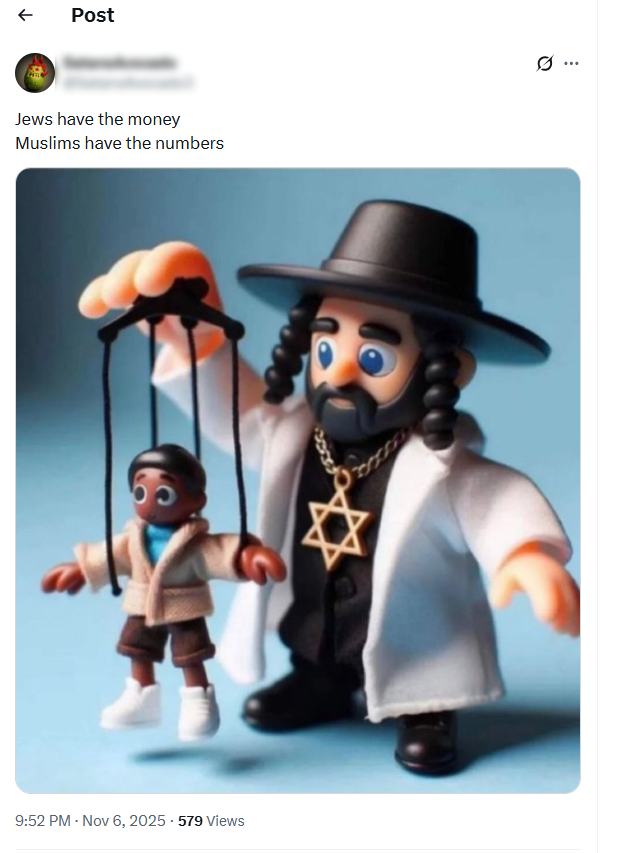
One notable aspect of the Israel-related antisemitism reported to CST in 2025 is how often it sits alongside conspiracy theories that were tenets of classical anti-Jewish hate long before the formation of a Jewish state in the Middle East. At least one of these myths was reported alongside Israel-related discourse in 444 antisemitic incidents reported to CST in 2025, making up 22% of the 1,977 incidents referencing the Middle East, compared to 19% of such incidents in 2024. Of these, 317 spoke of disproportionate Jewish control in the world through Israel’s supposed power over global politics or manipulation of politicians, often through financial means. Other incidents involved sickening claims of Mossad’s involvement in the terror attacks on Heaton Park Synagogue and Bondi Beach, allegedly as a way of garnering sympathy and support for Israel and Jews. One Hundred and forty-six antisemitic incidents referenced falsehoods about Jewish religious rituals in the context of Israel, usually invoking the centuries-old conspiracy of the Blood Libel, wherein the tragic death of innocent children in Gaza is framed as the consequence of the supposed Jewish lust for infant mutilation and blood. Whether or not purveyors of these canards are familiar with their origins and historical weaponisation, their presence in Israel-related anti-Jewish hate today demonstrates both the ubiquity of these narratives and the way that the language and context of antisemitism may change, but the ideas that underpin it do not. The growing percentage of conspiracy theories within Israel-related anti-Jewish hate may also be a sign of increased radicalisation within the anti-Israel sphere since 7 October 2023.

While much of the anti-Israel sentiment that descends into antisemitism reported to CST emanates from far-left thought, there were 66 Israel-related incidents recorded in 2025 that celebrated the events and architects of the Holocaust, and 50 that explicitly evidenced far-right motivation. Far-right, Israel-related incidents that were not Holocaust-related instead peddled various anti-Jewish ideas: “Zionists” were accused of being lesser humans than white Christian Europeans, or of being disloyal to the countries in which they live, or held responsible for engineering war in the Middle East to prompt the mass immigration of Muslims into Western countries – an alleged result of which was the terror attacks in Washington, Manchester and Sydney. The far-right discourses pervading Israel-related antisemitism showcase the mechanism of contemporary anti-Jewish hate, wherein traditional doctrines of extreme left-wing and extreme right-wing antisemitism overlap in their centralising demonisation of Israel, Zionism and, to varying degrees of unambiguity, Jews.

The discourses, motivations and ideologies discussed within this chapter illustrate the breadth of anti-Jewish hate, the opportunism of its purveyors, and the complexity of tackling it. This is a hatred that draws on well-established and deeply embedded myths, stereotypes, conspiracies and fantasies. Its perpetrators, who exist across the sociopolitical spectrum, give them new life, moulding them to fit their worldview and the world around them. Of the 2,821 antisemitic incidents recorded by CST in 2025 that featured at least one of the discourses explored in this chapter, 578 (20%) combined at least two of them.
Geographical locations
Of the 3,700 antisemitic incidents recorded by CST in 2025, 2,269 occurred in Greater London and Greater Manchester, the two UK cities where the largest Jewish populations reside.
In the former, 1,844 antisemitic incidents were reported, a fall of 1% from the 1,863 incidents recorded in 2024. Greater Manchester’s total of 425 cases of anti-Jewish hate is a drop of 11% from 2024’s regional figure of 480.
CST recorded at least one incident in each London borough bar Croydon in 2025. Of the 1,844 incidents reported across Greater London, 816 – 44% of London’s total – occurred in Barnet, the local authority that is home to the biggest Jewish population in the country. There were 191 instances of antisemitism reported to have taken place in Westminster, 139 in Camden, 59 in Hackney and 57 in Harrow. Jewish people live, work, attend school and pray in each of these boroughs, so it is no surprise to see them feature as the top five borough for cases of anti-Jewish hate. Within this subset, the borough of Westminster has ranked higher since October 2023 than it typically did previously. Although usually in the top five due to its geographical and political centrality, it would rarely be second only to Barnet before 2023. One reason for this shift is Westminster’s hosting of anti-Israel demonstrations, vigils for the hostages taken by Hamas, marches against antisemitism and remembrance services for the victims of 7 October. Although most people who attend these occasions conduct themselves respectfully and peacefully, they do attract people who use them as opportunities to express their hatred of Jews. At least 47 instances of antisemitic hate speech, placards and leaflets were reported at, or in transit to or from, these events in Westminster. This borough is also the locus of several Jewish institutions, synagogues and Members of Parliament or people of prominent political status. In 2025, 31 of Westminster’s 191 cases of anti-Jewish prejudice targeted Jewish organisations, 24 targeted synagogues and 15 targeted high-profile individuals.
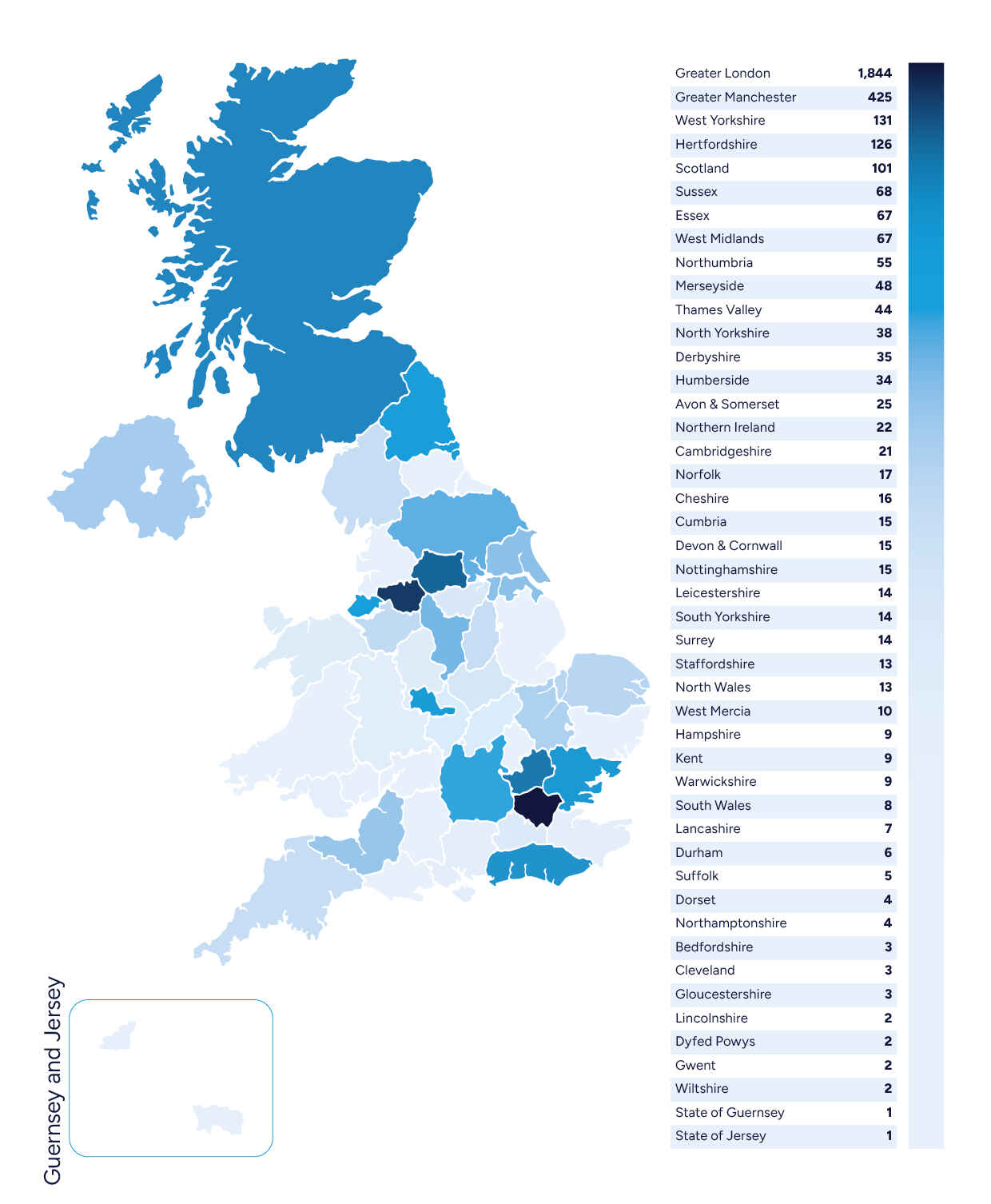
Within Greater London’s statistics are 117 incidents that took place on the London transport network, 79 of which happened on property that falls under the remit of the British Transport Police. A further 258 were online incidents where either the victim or offender is understood to be based in London, but a more specific location could not be established. The figure for Greater London would be even higher were it not for a technical problem since March 2024 that has disrupted the flow of reports received from the Metropolitan Police as part of CST’s information exchange with police forces. CST’s daily collaboration with the Metropolitan Police – and all police services across the country – remains a fundamental element of fulfilling CST’s mission to facilitate Jewish life and protect the Jewish community.
Of Greater Manchester’s 425 antisemitic incidents, 135 took place in the City of Manchester, 113 in Bury, 89 in Salford, 20 in Stockport and 15 in Trafford. Within this data set, 19 cases of anti-Jewish hate took place on Greater Manchester’s transport network, and 12 were online incidents where either the victim or offender is known to be based in Manchester, but a more specific location could not be established.
Taken together, the antisemitic incidents recorded across Greater London and Greater Manchester comprise 61% of the annual total, whereas they contributed 66% of all incidents nationally in 2024. It indicates that, while the majority of anti-Jewish hate incidents remain local to the areas where Jewish community is most deeply established and visible, the geographical spread of reported antisemitism was slightly broader in 2025 than the year before. Contemporary antisemitism does not require proximity to Jewish life to be expressed and heard, and CST logged at least two reports of anti-Jewish hate in every single one of the UK’s mainland police regions, as well as one report on each of the Isles of Guernsey and Jersey. In 2024, Lincolnshire was the only mainland police constabulary in which CST did not record an incident. Antisemitism can and does happen all over the UK because Jewish people live and work all over the country, even if many areas do not have a substantial Jewish community. Antisemitism also happens all over the country because antisemites exist all over the country and, with access to online platforms, can share their hatred far and wide at the touch of a button, whether or not there are Jewish people nearby.
In this modern context, CST has expanded its virtual footprint, broadening the public’s capacity to report both online and offline antisemitism. Partnership and data-sharing agreements with the police on local and national levels have been vital in broadening CST’s understanding of where and how anti-Jewish hate manifests across the UK. Of the 3,700 antisemitic incidents recorded by CST in 2025, 587 (16%) were reported to CST by the police.
Aside from Greater London and Greater Manchester, the police regions with the highest antisemitic incident totals reported in 2025 were West Yorkshire with 131 incidents (compared to 184 in 2024); Hertfordshire with 126 (an increase from 121 in 2024); Scotland with 101 (up from 74 in 2024); Sussex with 68 (a rise from 53 in 2024); and Essex and West Midlands with 67 each (increasing from 61 and 64 respectively in 2024).
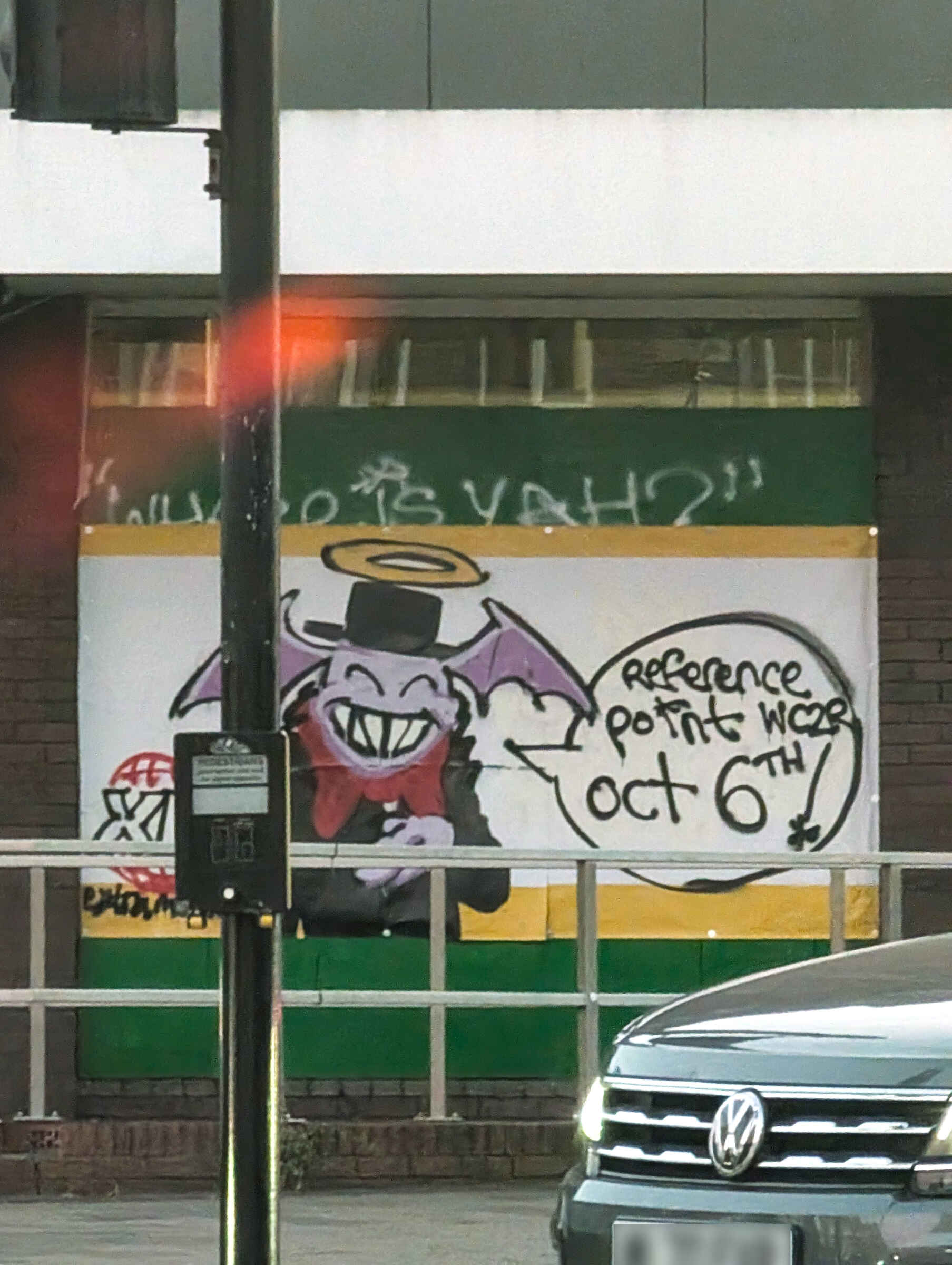
Apart from Greater London and Greater Manchester’s boroughs, the cities and towns where antisemitism was most often reported were Leeds in West Yorkshire (89 incidents); Borehamwood & Elstree in Hertfordshire (61 incidents); Birmingham in West Midlands (58 incidents); Brighton & Hove in Sussex (52 incidents); and Liverpool in Merseyside (43 incidents).
Included within all the figures in this chapter are the 145 instances of anti-Jewish hate that took place on public transport or at transport stations: 37 on London buses, 68 on the London Underground, and 32 on other transport services. An additional seven incidents were recorded in private taxis, and one incident was reported on an aeroplane while on the ground in the UK. Twelve of these 145 combined incidents were classed as Assault, one as Damage & Desecration to Jewish property, eight as Threats, and 124 as Abusive Behaviour.
Under-18s were disproportionately over-represented amongst both victims and offenders of antisemitic incidents on transport in 2025. Children were targeted in 49 (49%) of the 100 incidents that occurred either on public transport or in private taxis (where CST obtained information about the victim or victims’ age). This is a high percentage when compared to the presence of child victims in just 16% of the cases of anti-Jewish hate (for which this information was available) that did not occur in these settings. In 23 of these 49 incidents, the children were on their way to or from school. Similarly, 21 (22%) of the 96 transport-related incidents where the offender or offenders’ age was described to CST involved perpetrators under the age of 18. In the 1,720 incidents that took place in other environments wherein the perpetrator’s approximate age was provided, just 191 (11%) involved offenders who were minors.
Incident reporters
Not every incident recorded by CST has an identifiable victim. Not every incident recorded by CST has an identifiable perpetrator; but every incident recorded by CST has a reporter. Antisemitic incidents are reported to CST in a number of ways, most commonly by telephone, email, the CST website, via CST’s social media profiles, or in person to CST staff and volunteers. Incidents can be reported to CST by the victim, a witness, or an individual or organisation acting on their behalf. In 2001, CST was accorded third party reporting status by the police. CST has a national Information Sharing Agreement with the National Police Chiefs’ Council (NPCC), and similar agreements with a number of regional forces, which allow CST to share antisemitic incident reports, fully anonymised to comply with data protection requirements, so that both CST and the police can glean as complete a picture as possible of the number and nature of reported antisemitic incidents. CST began sharing antisemitic incident data with Greater Manchester Police in 2011, followed by the Metropolitan Police Service in 2012. Now, using the national agreement, CST shares anonymised antisemitic incident data with several forces around the UK. Any duplicate incidents that are reported to both CST and the police are excluded from this process to ensure there is no ‘double counting’ of incidents.
This collaboration continues to prove a core part of CST’s work. In 2025, 587 of the 3,700 antisemitic incidents recorded by CST were reported by police, 16% of the total. It is a decrease in number and proportion from 2024, when 637 incidents were reported by police, 18% of the annual figure. This is in part due to a disruption to the flow of reports sent by the Metropolitan Police from March 2024, caused by an IT issue. The Metropolitan Police Service remains a vital partner to CST and a key colleague in CST’s daily work.
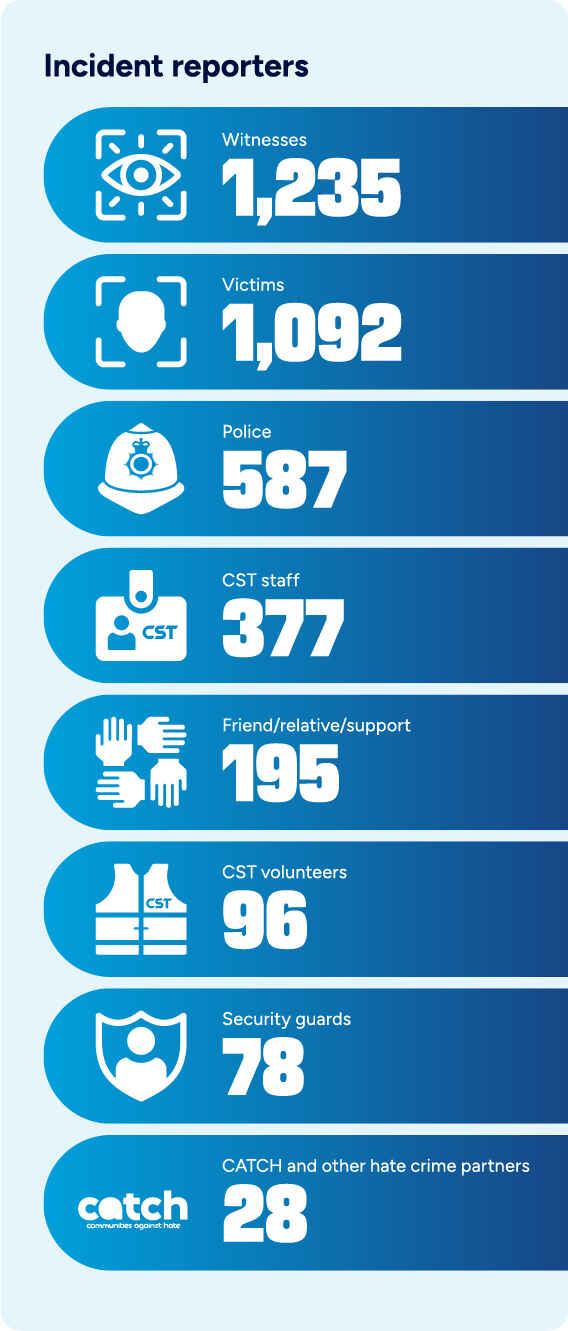
Greater Manchester Police provided 230 of the 587 antisemitic incidents reported to CST by police. Meanwhile, 60 came from West Yorkshire Police, 38 from Essex Police, 33 from Northumbria Police, 28 from Derbyshire Police, 28 from Humberside Police, and 170 from other police services around the country. Some of these partnerships have existed for a long time, others are newer, and it is a reflection of the work and time invested in building and maintaining these relationships that the police are able to contribute so immensely to CST’s antisemitic incident data, informing CST’s understanding of the landscape of anti-Jewish hate in the UK.
In 2025, 1,092 of the 3,700 antisemitic incidents recorded by CST were reported by the victim, while 1,235 were reported by a witness to antisemitism, whether exhibited online or in a public space. In 195 instances, a friend, relative or support provider related details of the incident. In total, victims, witnesses and those close to the victim reported 68% of the anti-Jewish hate incidents recorded by CST in 2025, building on 62% in 2024, 56% in 2023 and 44% in 2022. While this proportionate increase is partly a consequence of the reduction in incident data from the Metropolitan Police, it also indicates a community with greater incentive to report antisemitism since 7 October 2023 and in the context of anti-Jewish terror on British soil. These events have intensified feelings of anxiety and uncertainty within the Jewish population: feelings which increase motivation to report antisemitism when it happens.
CST staff reported 377 instances of antisemitism, which includes online abuse directed at CST social media accounts and email addresses, while 96 incidents were reported by CST volunteers. A further 78 incidents came to CST’s attention through security guards at Jewish locations, while 18 incidents were uniquely forwarded by the Community Alliance To Combat Hate (CATCH), a partnership of community organisations in London to whom those who report hate crime to the police can be referred if they want specialist support. Ten reports were made by other hate crime partners, seven were recorded from reports in the media, three reports were made by Shomrim, and two via university chaplaincies.
Every single report helps CST better understand the nature and scale of antisemitism in the UK. Every single report better enables CST to protect, support and facilitate Jewish life.
Information collection and suspicious behaviour
One of the most important jobs CST does is to record and analyse incidents of potential hostile reconnaissance, categorised by CST as Information Collection and Suspicious Behaviour around Jewish locations. Although these potential incidents are not included in CST’s antisemitic incident statistics, they still form a vital part of CST’s work as they relate directly to the security of the Jewish community.
The recent terror attacks on Heaton Park Synagogue, Manchester, and on a public Chanukah ceremony in Bondi Beach, Sydney, bring the necessity of this work into sharp focus. When added to the tragic history of antisemitic terrorism perpetrated in recent years against Jewish communities in many countries, including at Jewish schools, synagogues, shops, museums and other buildings in Colleyville, Pittsburgh, Halle, San Diego, Copenhagen, Paris, Brussels, Toulouse, Kansas City, Mumbai and elsewhere, as well as the numerous foiled plots to attack Jewish communities, the importance of this work is not to be underestimated: it saves lives.
Jewish communities have long been the targets of terrorists of different and varied political and religious motivations. Since the late 1960s, there have been hundreds of terrorist attacks, attempted attacks and foiled terrorist plots against Diaspora Jewish communities and Israeli targets outside Israel. In the UK, several terrorist plots involving the aspiration to attack the Jewish community came to trial or were publicised via the media in recent years. It is well known that terrorist actors often collect information about their targets before launching an attack: identifying and preventing the gathering of this kind of information is an integral part of CST’s security operations protecting the UK Jewish community from terrorism. To be effective in keeping the public safe, CST relies on information from the public as well as CST’s own volunteers and from commercial guards, and CST encourages the Jewish community to report any suspicious activity to CST, as well as to the police.
CST works closely with the police to gather, record and investigate incidents of Information Collection and Suspicious Behaviour. CST does this to keep the Jewish community safe and allow it to carry on as normal. The vague and uncertain nature of many of these incidents means that they are easier to analyse if the two categories are combined, rather than treated separately. However, cases of potential Information Collection and Suspicious Behaviour are not included in CST’s antisemitic incident statistics, as the motivation for many of them cannot be determined and many may have innocent explanations.
Together, there were 748 such incidents reported to CST in 2025 – an annual record – compared to the 642 incidents of this type recorded in 2024. Many of these incidents involved the filming or photography of Jewish buildings, loitering suspiciously around them, and/or the attempted entry to Jewish premises. There were 672 instances of Information Collection and Suspicious Behaviour reported in 2023, and just 235 in 2022. One hundred and fifty-one (20%) of these 748 incidents occurred in October, reflecting increased alertness to potential hostility in the aftermath of the attack on Heaton Park Synagogue at the start of the month, and across the subsequent High Holy Days. Taking the longer view, it is likely that this sustained increase since 2023 is a result of the overall rise in antisemitism since the 7 October Hamas attack on Israel that year, the general unwanted attention given to the Jewish community ever since, and the consequent increase in Jewish sensitivity and anxiety. These factors have intensified feelings of fear and insecurity among the community, and a heightened sense of alert has led to more reports of perceived hostile activity. Although most of these reports are likely to have innocent explanations, neither CST nor the police underestimate the threat posed to Jewish communities by various terrorist organisations and networks. Identifying and preventing the potential hostile reconnaissance of Jewish buildings or other potential terrorist targets is an important part of reducing the possibility of future terrorist attacks and is integral to the work of CST.
Annual antisemitic incident figures
Some of the numbers in the tables may differ from those previously published by CST, due to the late reporting of incidents to CST by incident victims and witnesses, or the recategorisation of some incidents due to new information.
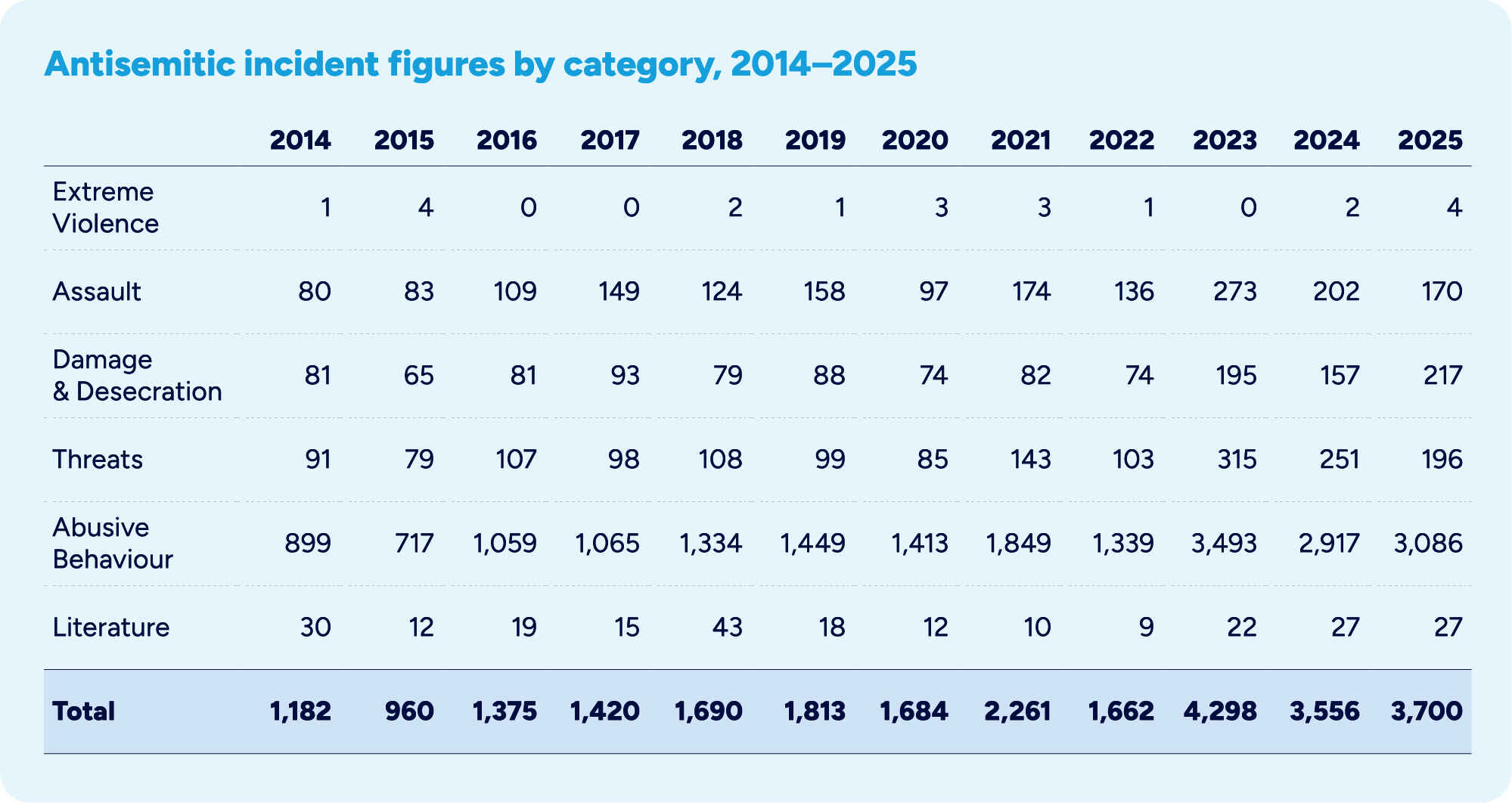
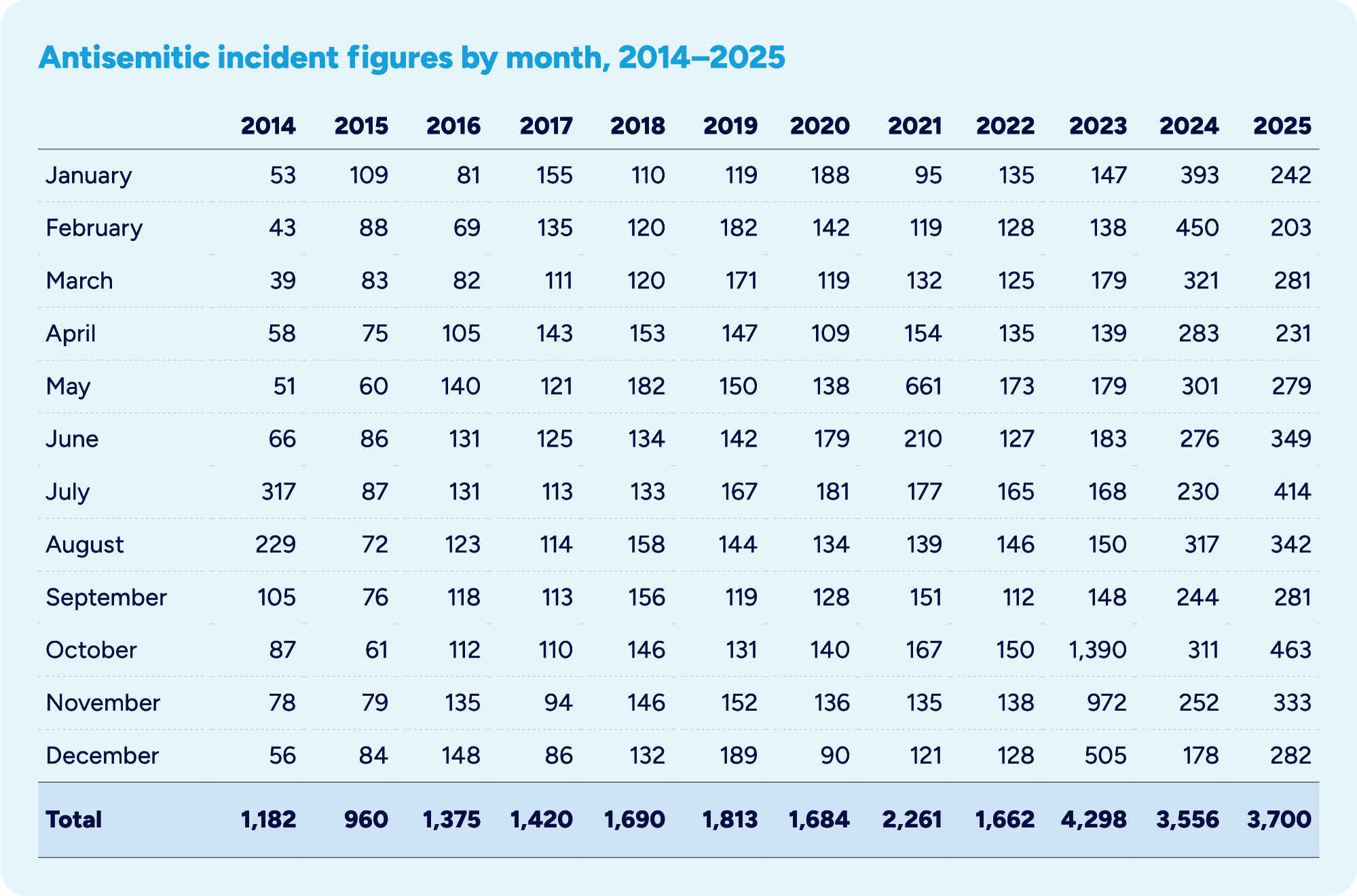
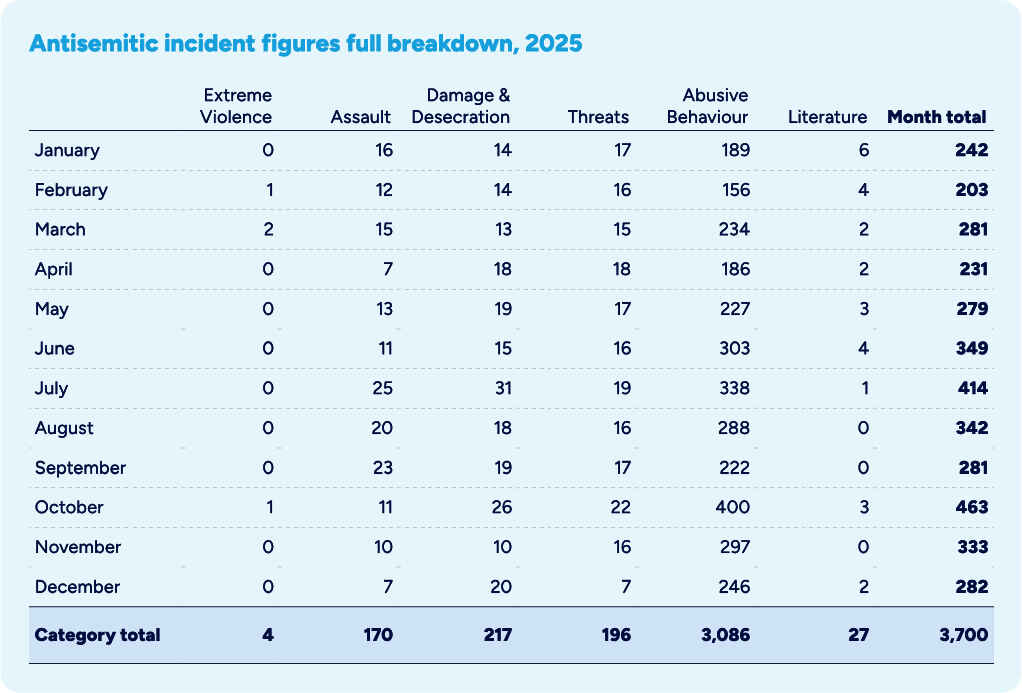
Footnotes
- The incident totals for past years and months in this report may differ from those previously published by CST, due to the late reporting of some incidents to CST by incident victims, witnesses or other sources. Figures published in this report are also subject to change for the same reason.
- The murder of Michael Kahan in 2008 involved the deliberate targeting of a Jewish victim and is the only other incident in CST’s records that involved loss of life, but was not classified as a terrorist incident.
- This total includes the terror attack itself.
- Antisemitic incidents are classed as connected to specific political parties based on the offender’s stated affiliation or support; because the abuse was targeted at, or expressed by, party members, activists or representatives; or because an incident appeared to be motivated by news stories related to that party. It is often not possible to ascertain whether the offenders are themselves party members or not; in some cases, they have been expelled from their former party but continue to express antisemitism in relation to it. These caveats mean that these totals are not indicators of the relative amounts of antisemitism within, or tolerated by, each political party.
- Scotland is treated as a single geographical area due to Police Scotland being a single police service, but any comparisons of the incident total for Scotland with other much smaller geographical regions should be done with caution.
- These include antisemitic abuse that took place inside and outside stadia; stickers and graffiti related to football clubs and supporter groups; online comments regarding football; and anti-Jewish replies to football clubs posting about Jewish holidays on social media.
- Police Definitions for Hate Crimes and Incidents
- Police agree data sharing protocols with the Community Security Trust and TELL MAMA
- Hate crime, England and Wales, year ending March 2025 - GOV.UK
- As outlined in footnote 2, the only other fatal antisemitic incident in CST’s records was the murder of Michael Kahan in 2008, but this was not classified as a terrorist attack.
- This figure includes the terrorist attack itself, which was one of four acts of Extreme Violence reported to CST in 2025.
- These include attacks where mixed groups of adults and minors were targeted, as do all the figures in this paragraph.
- This qualifies as Jewish property as it was Jewish people who printed and put them up, and the majority of the posters’ and memorials’ subjects are Jewish too.
- This figure includes bomb threats sent to multiple Jewish locations around the country simultaneously, which CST counts as a single incident.
- Forty-four of these 46 incidents targeting Jewish organisations and 28 of these 32 incidents targeting public figures were online. Hundreds of antisemitic comments were brought to CST’s attention, but CST logs coordinated campaigns of anti-Jewish harassment as a single incident, even if it involves multiple posts, in order to preserve the integrity of CST’s published figures.
- Far-right discourses that did not include Nazi-related references involved The Great Replacement conspiracy theory, descriptions of Jews as being less human than white people, allegations of Jewish disloyalty to the UK, rejection of the idea that Jewish people can be British, arguments that Jewishness and left-wing movements are one and the same, and the perpetrators’ clear allegiance to modern far-right groups or alignment to far-right thought.