CST Blog
Antisemitic Incidents Report 2025
11 February 2026
Read the full Antisemitic Incidents Report 2025
CST’s Antisemitic Incidents Report 2025, published today, shows 3,700 instances of anti-Jewish hate across the UK in 2025. This is the second highest annual total ever reported to CST. It is a 4% rise from the 3,556 antisemitic incidents in 2024, and second only to the 4,298 antisemitic incidents logged in 2023. CST recorded 1,662 antisemitic incidents in 2022, and 2,261 in 2021.
A further 3,001 potential incidents were reported to CST that are not included among this report’s statistics as, upon analysis, they were not deemed to be antisemitic. Many of these incidents involve suspicious activity or possible hostile reconnaissance at Jewish locations, criminal activity affecting Jewish people and buildings, and anti-Israel activity that did not include antisemitic language, motivation or targeting. Combined with the antisemitic incidents recorded, CST handled over 6,700 reports in 2025 which required a mixture of victim support and follow-up, further investigation, security advice, and liaison with police, local authorities and other institutions.
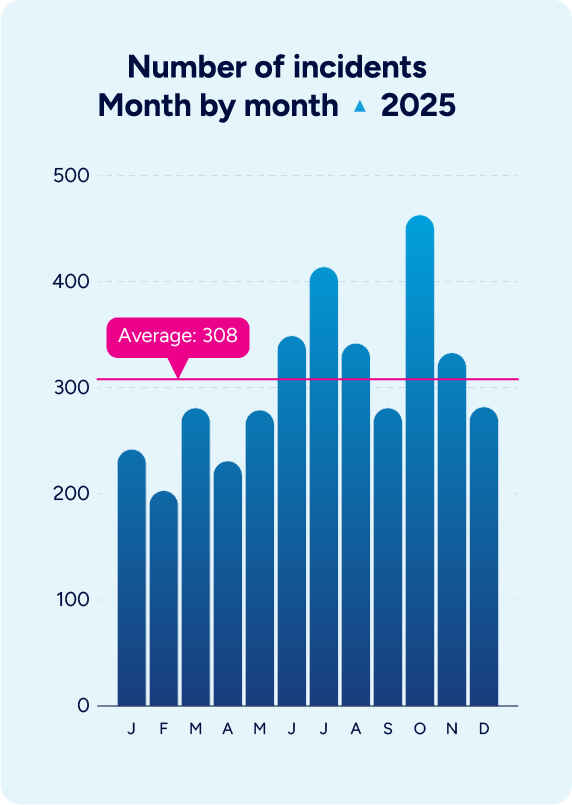
The annual total reflects that antisemitic incident levels remain significantly higher than was the case prior to 7 October 2023. CST recorded an average of 308 antisemitic incidents per month, exactly double the monthly average of 154 incidents reported in the year preceding Hamas’ attack on Israel. For the first time ever, CST recorded over 200 cases of anti-Jewish hate in every calendar month in 2025. Prior to October 2023, monthly incident totals exceeding 200 had only been reported on CST on five occasions, each coinciding with past periods when Israel was at war.
The worst month was October, with 463 antisemitic incidents reported, the fifth highest monthly total ever logged by CST and 63% higher than September’s figure. This was in part the legacy of the year’s most serious and devastating incident, which occurred at the beginning of October. On Yom Kippur, the holiest day in the Jewish calendar, Heaton Park Synagogue in Manchester was the target of a terrorist attack which resulted in the deaths of Melvin Cravitz z’’l and Adrian Daulby z’’l, with three others seriously injured. This was the first fatal antisemitic terrorist attack on British soil since CST began recording incidents in 1984.
It sparked the highest daily totals for anti-Jewish hate incidents recorded throughout 2025, with 40 cases logged on the day of the attack and 40 on the day after it. Over half of these 80 incidents were antisemitic reactions to the violence, celebrating it, dismissing it, or spinning conspiratorial narratives about it. A smaller spike was recorded in December following the Islamic State‑inspired attack at a Chanukah event in Bondi Beach, Australia. When Jewish communities are perceived to be vulnerable, antisemites take the opportunity to pile on with their hatred.
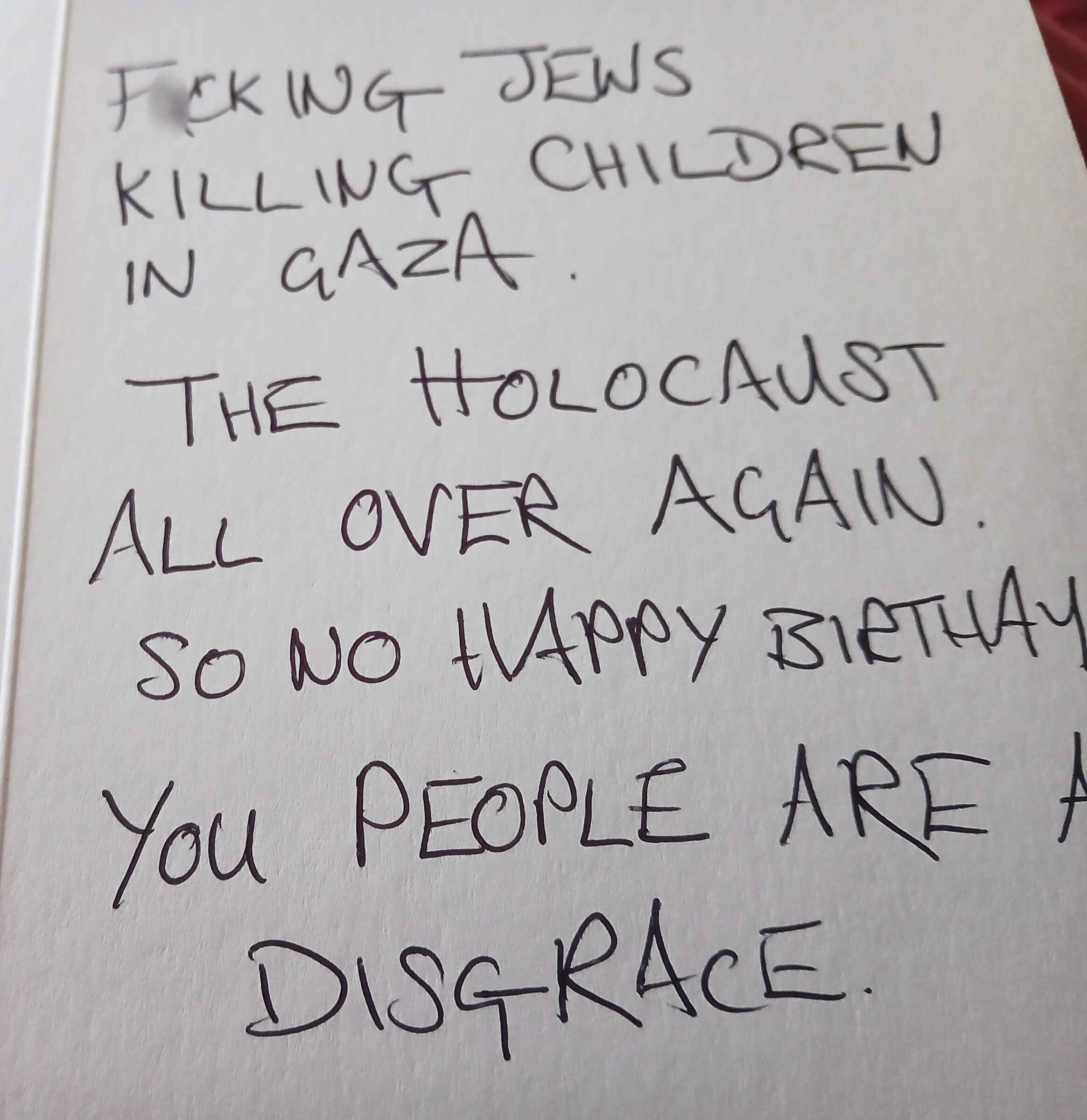
This phenomenon was observed in the immediate aftermath of 7 October, when a huge volume of anti-Jewish hate was reported before Israel had initiated any coordinated ground incursion in Gaza, and events in the region continued to impact the amount and contend of antisemitism in 2025. In 1,977 incidents – 53% of the annual total – the offender referenced Israel, Palestine, the Hamas terror attack or the subsequent war. Each of these cases also evidenced anti-Jewish language, motivation or targeting. There were 1,766 antisemitic incidents that showed explicitly anti-Zionist motivation, instances of anti-Jewish hate wherein the terms “Zionism” or “Zionist” were used, often as euphemisms for “Jewishness” and “Jew”, or in conjunction with other antisemitic sentiment, while Israel, Israelis or Jewish people were equated with Nazi Germany or the Nazis on 387 occasions. There were 32 antisemitic incidents where the phrase “Death to the IDF” was used in explicitly anti-Jewish contexts, all 32 of which occurred following the punk-rap group Bob Vylan had used the phrase on stage at the Glastonbury Festival. There were no reported examples of it being used prior to that event. This emergence of a new slogan deployed by antisemitic incident perpetrators is symptomatic of how national culture, major news events, and social media networks, can influence the language of hate.
CST recorded four incidents that involved Grievous Bodily Harm or threat to life in 2025 (including the fatal attack at Heaton Park Synagogue), meaning that they were severe enough to be categorised as Extreme Violence, double the number recorded in 2024 and more than the total for the previous three years combined. There were an additional 170 cases of antisemitic Assault. Taken together with the four reports of Extreme Violence, physical attacks accounted for 5% of all incidents, compared to 6% in 2024. Incidents of Damage & Desecration of Jewish property rose sharply by 38% to a record 217 cases, including attacks on homes, vehicles, synagogues, schools, Jewish businesses and hostage memorials. CST recorded 196 direct antisemitic Threats, 27 cases of mass-produced antisemitic Literature, and 3,086 instances of Abusive Behaviour. The latter is the widest and most frequently logged category of anti-Jewish hate, accounting for 83% of all antisemitic incidents in 2025.
A record 1,541 incidents occurred on online platforms, 42% of the annual total and 23% higher than 2024’s figure for virtual anti-Jewish hate. Of the 1,541 reports of online anti-Jewish hate, 1,080 (70%) were in some way related to events in the Middle East. This was true of only 897 (42%) of the 2,159 ‘offline’ antisemitic incidents recorded in 2025.
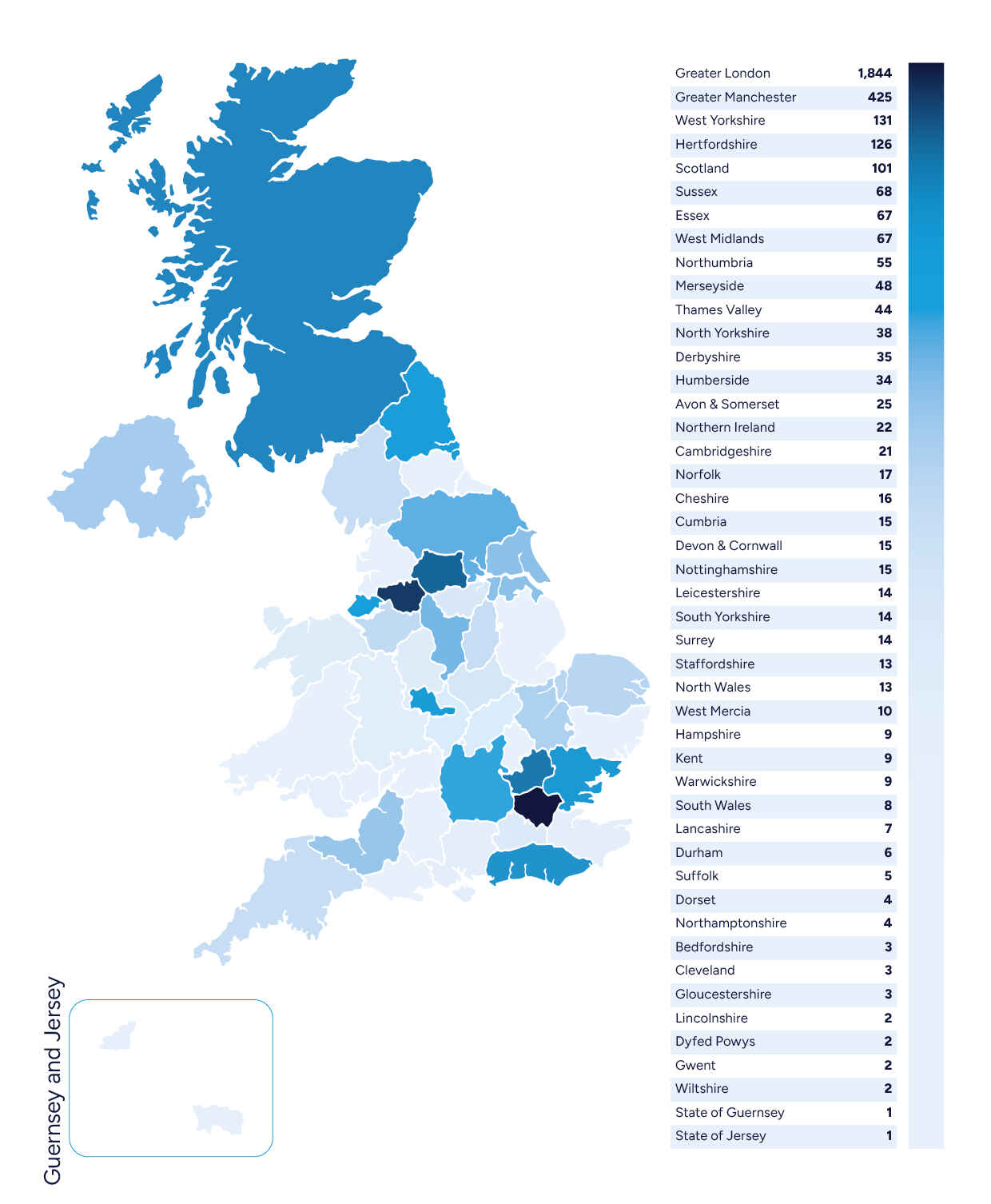
In 2025, 1,844 antisemitic incidents were reported to have taken place in Greater London, falling by 1% from 2024’s total of 1,863 London-based incidents. CST recorded 425 antisemitic incidents in Greater Manchester, a decrease of 11% from the 480 incidents in the corresponding area in 2024. Their combined contribution to the overall figure is 61%, and these areas where Jewish life is most deeply established remain the principal targets of antisemitism.
Elsewhere, the police regions with the highest levels of reported antisemitism in 2025 were West Yorkshire with 131 incidents, Hertfordshire with 126 incidents, Scotland with 101 incidents, Sussex with 68 incidents, and Essex and West Midlands with 67 incidents each.
Read More

Antisemitic Incidents Report January-June 2025
6 August 2025
Antisemitic Incidents Report 2024
12 February 2025
Antisemitic Incidents Report January-June 2024
8 August 2024